Global capital markets are entering a decisive phase. Across the United Kingdom and Europe, corporate leaders are weighing Bank of England interest rate hike forecasts alongside October inflation data, UK Treasury Autumn Budget bank tax discussions, and persistent energy pressures from German gas shortages and European clean air zones. Meanwhile, major equity markets face heightened volatility driven by the AI boom versus bubble debate, executive shake-ups across semiconductor leaders, and widespread enterprise disruptions following global Microsoft 365 and air traffic control outages. Against this backdrop of tighter Western monetary policy and geopolitical friction, HPC Consultancy Ltd is advising institutional buyers, family offices, and private equity funds that now represents an exceptional window to acquire private high-net-worth companies in the Gulf Cooperation Council at disciplined, attractive valuations.
Valuation Discipline and Regional Resilience
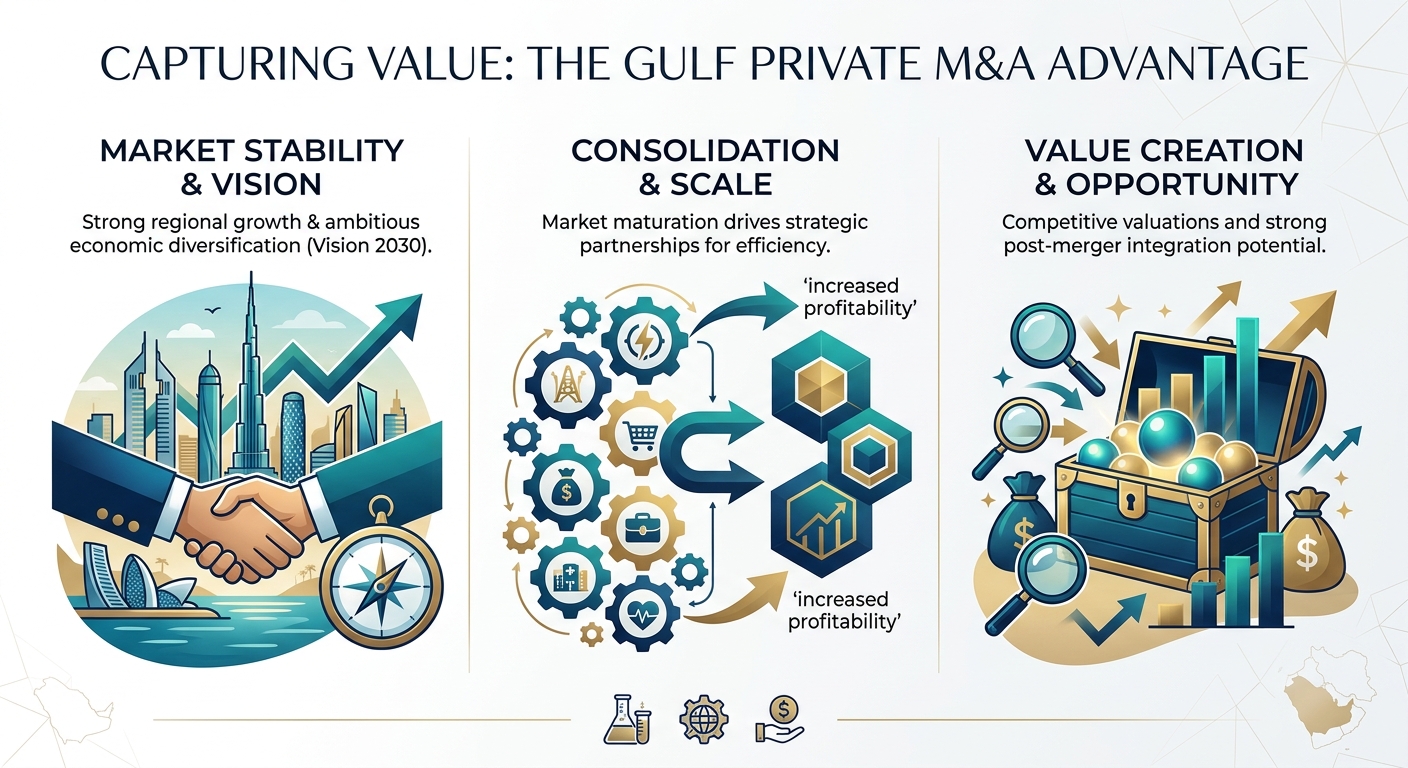
While Western economies contend with rising borrowing costs and African sovereigns shift toward domestic debt markets to manage dollar funding expenses, the Gulf region continues to demonstrate robust economic fundamentals and active capital deployment. Valuation expectations among family-owned and founder-led businesses across the UAE, Saudi Arabia, and neighbouring Gulf states have normalized, creating compelling entry multiples for strategic acquirers. Rather than competing in overheated public auctions, international buyers can secure profitable, cash-generative private enterprises at favorable rates before the next cycle of regional expansion drives multiples higher.
High-Growth Sectors Attracting Institutional Capital
Across the GCC, national economic diversification programmes are generating sustained momentum across critical commercial sectors. Institutional buyers working with our advisory practice are targeting established private enterprises benefiting from structural regional tailwinds:
-
Logistics and maritime infrastructure operators positioned along vital trade routes, supported by major initiatives such as the Duqm-Khalifa Green Corridor and ongoing Gulf maritime corridor security investments.
-
Financial technology and digital banking platforms thriving within progressive regulatory ecosystems, bolstered by developments like the Qatar Central Bank Madar Innovation Center, the SPC Free Zone and Wio Bank partnership, and insights from the Singapore FinTech Festival 2026.
-
Real estate, hospitality, and consumer platforms capitalizing on UAE property market expansion, major food security deals from Global Food Week in Abu Dhabi, and bilateral trade agreements linking the Gulf with India, the United States, and Mozambique.
-
Advanced technology and clean energy enterprises aligned with regional sovereign priorities, including quantum computing partnerships, Saudi aviation expansion, and Oman carbon market development.
Cross-Border Corridors and Strategic Arbitrage
International investors from the UK, Europe, Asia, and Africa are increasingly using Gulf acquisitions to diversify revenue streams and insulate portfolios from localized headwinds. Whether offsetting European automotive tariff uncertainty, UK-EU post-Brexit border friction, or Asian supply chain adjustments discussed at the 49th ASEAN Summit and APEC diplomatic meetings, acquiring an established GCC operating platform provides immediate access to high-growth consumer and institutional markets. Furthermore, sovereign-backed infrastructure spending and strong domestic liquidity ensure that well-structured private businesses in the Gulf maintain resilient margins even when global freight and energy costs fluctuate.
Independent Advisory and Confidential Deal Execution
Acquiring private high-net-worth companies in the Middle East requires deep regional fluency, strict confidentiality, and rigorous transaction structuring. HPC assists international buyers in identifying vetted, off-market family enterprises, conducting comprehensive financial and regulatory due diligence, and structuring cross-border acquisitions that protect buyer capital while respecting founder legacy.
If your fund, family office, or corporate group is evaluating strategic acquisitions or private equity investments across the GCC, contact the HPC advisory team today to review active mandates.
1. Why is now considered an opportune time for investors from Worldwide to acquire private companies in the GCC?
Valuation expectations among Gulf founders have normalized, allowing disciplined buyers from Worldwide to acquire profitable, cash-generative private businesses at attractive entry multiples before broader capital inflows push prices upward.
2. How does HPC assist investors from Worldwide in identifying off-market GCC acquisition targets?
HPC provides independent commercial advisory, buyer credentialing, and confidential deal origination, connecting investors from Worldwide directly with vetted private high-net-worth enterprises across the UAE, Saudi Arabia, Qatar, Oman, Kuwait, and Bahrain.
3. How do Bank of England interest rate hike forecasts and October inflation data affect cross-border M&A decisions?
Rising borrowing costs and persistent inflation in Western markets, highlighted by Bank of England interest rate hike forecasts and October inflation data, encourage investors to deploy equity into high-growth, low-tax Gulf businesses with strong cash conversion.
4. What impact do UK Treasury Autumn Budget bank tax changes have on institutional capital allocation?
Potential fiscal tightening, such as UK Treasury Autumn Budget bank tax changes, prompts financial institutions and family offices to diversify capital into tax-efficient GCC jurisdictions.
5. Which GCC sectors offer the strongest acquisition potential for buyers from Worldwide?
Logistics, fintech, healthcare, education, luxury real estate, consumer goods, and technology-enabled services represent the most active sectors for cross-border acquisitions across the Gulf.
6. How do Gulf maritime corridor security and regional geopolitical tensions affect private business valuations?
While Gulf maritime corridor security and regional geopolitical tensions require careful supply chain due diligence, domestic-focused and infrastructure-backed GCC enterprises continue to deliver resilient earnings and attractive risk-adjusted valuations.
7. Can investors from Worldwide acquire 100 percent ownership of private companies in the UAE and Saudi Arabia?
Yes, recent commercial company law reforms across both the UAE and Saudi Arabia permit 100 percent foreign ownership across the vast majority of mainland and free zone business activities.
8. How do UAE property market expansion and rising real estate investment across emirates support corporate M&A?
Strong UAE property market expansion and rising real estate investment across emirates drive sustained demand for property management, facilities maintenance, construction supply, and hospitality service companies.
9. What lessons did enterprises learn from the global Microsoft 365 and enterprise cloud service restoration?
The global Microsoft Teams and Outlook outage recovery across UK businesses and African enterprises, alongside Microsoft 365 service recovery across Gulf enterprises, underscores the value of acquiring firms with diversified, resilient IT infrastructure.
10. How do UK-EU Eurotunnel border checks breakthrough and post-Brexit trade rules compare with GCC trade integration?
While European firms adjust to UK-EU Eurotunnel border checks breakthrough and post-Brexit trade rules alongside UK-EU sanitary and phytosanitary border check negotiations, the GCC offers streamlined intra-regional customs corridors and expanding bilateral trade treaties.
11. Why are family-owned businesses in the GCC seeking strategic buyers or partners?
Many second- and third-generation Gulf family enterprises face succession transitions, governance modernization needs, and regional scaling ambitions, making them receptive to experienced international partners.
12. How does HPC protect buyer confidentiality during initial GCC deal inquiries from Worldwide?
HPC enforces strict staged non-disclosure agreements and verifies investor liquidity before sharing sensitive corporate financials, asset valuations, or founder identities.
13. How do global aviation disruptions—such as the FAA air traffic outage and transatlantic flight disruptions—affect Gulf business operations?
Despite temporary shocks like the FAA air traffic outage and transatlantic flight disruptions or global air travel disruptions and grounded flights across Asian hubs, Gulf aviation hubs continue expanding capacity, exemplified by Riyadh Air unveiling its first Airbus A321neo in pearl livery.
14. What role do free zones play in structuring GCC acquisitions for investors from Worldwide?
Financial free zones like DIFC and ADGM offer English common law frameworks, independent courts, and streamlined banking integration, illustrated by initiatives such as the SPC Free Zone and Wio Bank partnership to streamline UAE business banking.
15. How do logistics corridors like the Asyad Group launching operations on the Duqm-Khalifa Green Corridor create M&A value?
Major infrastructure milestones, such as Asyad Group launching operations on the Duqm-Khalifa Green Corridor, boost the strategic value of private freight, warehousing, and cold-chain logistics companies across Oman and the UAE.
16. How does the AI boom versus bubble debate and global tech stock valuations influence private equity strategy?
Volatility surrounding the AI boom versus bubble debate and global tech stock valuations, compounded by the Jensen Huang exit and Nvidia leadership scandal and Nvidia executive shake-up and global semiconductor market reaction, drives investors toward profitable private enterprises with tangible cash flows.
17. What due diligence standards are critical when auditing private high-net-worth companies in the GCC?
Buyers must conduct thorough financial audits to normalize owner-related expenses, verify commercial licensing, inspect customer concentration, and confirm compliance with local labour and corporate tax rules.
18. How do bilateral agreements like Saudi Arabia and US bilateral trade, investment, and affordable housing agreements benefit private sector firms?
High-level frameworks, including Saudi Arabia and US bilateral trade, investment, and affordable housing agreements, unlock substantial government procurement pipelines and joint-venture opportunities for established private contractors.
19. How are Gulf sovereign investments in advanced tech—such as EDGE investment in Q-CTRL to advance UAE quantum technology capabilities—shaping the private tech ecosystem?
Strategic sovereign backing, demonstrated by EDGE investment in Q-CTRL to advance UAE quantum technology capabilities, elevates regional technical standards and creates exit pathways for private B2B technology firms.
20. What opportunities exist in the GCC food and agribusiness sector following Global Food Week in Abu Dhabi closing with $1.88 billion in deals?
Strong sector momentum, highlighted by Global Food Week in Abu Dhabi closing with $1.88 billion in deals, creates attractive buy-and-build opportunities in food distribution, agritech, and processing facilities.
21. How does fintech growth, supported by Qatar Central Bank opening the Madar Innovation Center for fintech growth and Singapore FinTech Festival 2026, impact regional M&A?
Regulatory sandboxes and innovation hubs, reflected in Qatar Central Bank opening the Madar Innovation Center for fintech growth and themes from the Singapore FinTech Festival 2026 and global financial infrastructure, accelerate consolidation among licensed payment and wealth-tech startups.
22. How do environmental and energy transitions—from Oman expanding international partnerships for carbon market development to EBRD $6 billion commitment for Türkiye renewable energy transition—affect industrial acquisitions?
Global sustainability initiatives, including Oman expanding international partnerships for carbon market development and the EBRD $6 billion commitment for Türkiye renewable energy transition, reward acquirers targeting clean energy services and industrial efficiency firms.
23. How do European industrial pressures—like Germany gas shortages and potential restart of coal-fired power plants and European clean air zones—drive capital toward the Gulf?
High energy expenses and strict compliance burdens, seen in Germany gas shortages and potential restart of coal-fired power plants and European clean air zones and rising urban freight delivery costs, make lower-cost Gulf manufacturing and logistics platforms highly competitive.
24. What lessons can acquirers draw from retail turnarounds such as Burberry share price rally and return to profit, B&M European Value Retail share surge on turnaround plan, and Premier Foods first dividend in two decades?
Corporate turnarounds like Burberry share price rally and return to profit, B&M European Value Retail share surge on turnaround plan, and Premier Foods first dividend in two decades prove that disciplined operational restructuring and brand positioning unlock substantial equity value.
25. How do automotive trade disputes—such as UK car industry push for two-year delay to post-Brexit electric vehicle tariffs and European automotive sector lobbying over electric vehicle tariffs—influence GCC automotive distribution deals?
Tariff uncertainty in Western markets, evident in the UK car industry push for two-year delay to post-Brexit electric vehicle tariffs and European automotive sector lobbying over electric vehicle tariffs, increases the appeal of stable, high-margin Gulf automotive dealerships and aftermarket service groups.
26. How do geopolitical and defence spending shifts, including the EU financial assistance package for Ukraine and European security spending, affect global capital flows?
Heightened sovereign spending priorities, such as the EU financial assistance package for Ukraine and European security spending, reinforce the importance of holding geographically diversified private assets across neutral, capital-rich Gulf economies.
27. Why is traditional private equity preferable to volatile digital assets amid crypto market volatility and Internet Computer (ICP) price drop?
Sharp drawdowns like crypto market volatility and Internet Computer (ICP) price drop highlight the superior capital protection and predictable dividend yields of established private operating companies.
28. How do Asian trade developments—such as the 49th ASEAN Summit in Manila, APEC diplomatic summit in China, and UAE and India bilateral investment talks at the 31st CII Partnership Summit—benefit GCC acquisitions?
Expanding East-West trade corridors, reinforced by the 49th ASEAN Summit in Manila and regional supply chain diversification, the APEC diplomatic summit in China and US-China trade relations, and UAE and India bilateral investment talks at the 31st CII Partnership Summit, position Gulf companies as vital distribution hubs between Asia, Europe, and Africa.
29. How do Asian macroeconomic shifts—like Malaysia 5% GDP growth outlook and Sarawak hydropower expansion versus Bangladesh new IMF programme talks and ready-made garment factory wage unrest—influence cross-border supply chains?
Contrasting regional dynamics, such as Malaysia 5% GDP growth outlook and Sarawak hydropower expansion alongside Bangladesh new IMF programme talks and ADB international debt conference and Bangladesh ready-made garment factory wage unrest, encourage Gulf importers to diversify vendor networks and strengthen local warehousing.
30. How do African resource and infrastructure shifts—including Angola, Botswana, and Namibia bidding for Anglo American's De Beers stake and UAE and Mozambique bilateral trade talks—connect with GCC investment strategies?
Deepening Gulf-Africa commercial ties, illustrated by UAE and Mozambique bilateral trade and economic cooperation talks alongside resource shifts like Angola, Botswana, and Namibia bidding for Anglo American's De Beers stake and Guinea artisanal gold mining ban and Siguiri clashes, create strong trade-finance and commodity logistics opportunities for GCC firms.
31. How do African infrastructure and financing challenges—such as South Africa R1.27 trillion infrastructure gap, private rail operator breaking Transnet's logistics monopoly, Nigeria NERC N30 billion electricity meter funding rollout, and China debt exposure across South Africa, Egypt, and Nigeria—affect Gulf corporate expansion?
As African economies address the South Africa R1.27 trillion infrastructure and energy funding gap, support a private rail operator breaking Transnet's logistics monopoly in South Africa, execute the Nigeria NERC N30 billion electricity meter funding rollout, and manage China debt exposure across South Africa, Egypt, and Nigeria and African sovereigns shifting to domestic debt markets as dollar borrowing costs rise, well-capitalized GCC engineering and utility firms are uniquely positioned to win regional contracts.
32. How does satellite connectivity expansion, such as the SpaceX $1 million Starlink grant across nine African countries, impact emerging market portfolio companies?
Expanding digital connectivity, exemplified by the SpaceX $1 million Starlink grant across nine African countries, enables Gulf-headquartered service and fintech platforms to scale seamlessly into neighbouring emerging markets.
33. What valuation methodologies does HPC use when pricing private high-net-worth companies in the GCC?
HPC applies discounted cash flow models, regional EBITDA multiple benchmarking, and normalized working capital adjustments to ensure investors from Worldwide pay fair, defensible prices.
34. How are earn-outs and deferred payments structured in GCC private acquisitions?
Advisors frequently use performance-linked earn-outs over 12 to 36 months to bridge valuation gaps and incentivize departing founders to deliver post-closing revenue targets.
35. What corporate tax rules apply to newly acquired private businesses in the UAE and Saudi Arabia?
The UAE applies a competitive 9 percent corporate tax rate on profits exceeding AED 375,000, while Saudi Arabia levies corporate income tax on foreign-owned shares alongside Zakat on GCC-owned equity.
36. How do investors from Worldwide repatriate dividends and exit proceeds from the GCC?
GCC currencies are pegged to the US dollar with zero foreign exchange controls, enabling unrestricted repatriation of profits, dividends, and capital gains to Worldwide.
37. What governance upgrades typically unlock immediate value after acquiring a Gulf family business?
Implementing institutional financial reporting, centralized ERP software, formal board oversight, and professional middle management rapidly enhances margins and exit multiples.
38. How long does a typical private company acquisition take to close in the GCC?
From initial NDA execution and commercial due diligence through regulatory licensing transfers and final closing, transactions typically take between three and six months.
39. Can investors from Worldwide use acquisition debt financing from regional Gulf banks?
Yes, local commercial banks and private credit funds actively provide leveraged acquisition finance for cash-generative mid-market buyouts with strong asset backing.
40. How does HPC handle cultural alignment during negotiations with Gulf high-net-worth founders?
HPC bridges international institutional standards with deep respect for personal trust, relationship continuity, and legacy preservation to keep negotiations constructive.
41. What legal protections cover minority versus majority equity acquisitions in the GCC?
Shareholders' agreements governed under DIFC, ADGM, or tailored commercial jurisdictions establish clear reserved matters, tag-along and drag-along rights, and dividend distribution policies.
42. How do Emiratisation and Saudisation workforce policies affect post-merger integration?
Acquirers must factor nationalization quotas and recruitment incentives into human capital planning to maintain top-tier government contract eligibility and licensing status.
43. What warning signs does HPC screen for during preliminary target vetting?
Advisors screen out businesses with unverified off-balance-sheet liabilities, excessive single-client dependency, unresolved regulatory disputes, or unsustainable founder-only sales models.
44. Can corporate buyers from Worldwide execute a roll-up strategy across multiple GCC countries?
Yes, acquiring a flagship platform in the UAE or Saudi Arabia provides an ideal operational base for bolt-on acquisitions across Qatar, Oman, Kuwait, and Bahrain.
45. How are intellectual property rights and brand trademarks protected during GCC transactions?
Legal due diligence verifies trademark registrations across national GCC ministries and transfers all proprietary software and brand assets into the acquiring holding structure.
46. What role does Warranty and Indemnity insurance play in cross-border Gulf deals?
International insurers increasingly underwrite Warranty and Indemnity policies for GCC transactions, protecting Worldwide buyers against unknown historical tax or compliance breaches.
47. How can investors from Worldwide verify real estate leases held by target operating companies?
Advisors inspect registered municipal lease contracts, musataha agreements, and renewal clauses to confirm long-term operational security for warehouses, offices, or retail sites.
48. Why is buying an established private company faster than setting up a greenfield entity in the GCC?
Acquiring an existing profitable business provides immediate commercial licenses, bank accounts, trained staff, supplier contracts, and established revenue from day one.
49. How does HPC tailor deal structures for family offices compared with corporate strategic buyers?
HPC aligns holding structures, governance involvement, and investment horizons with each buyer's mandate, whether targeting long-term dividend yield or operational synergy.
50. How can investors and corporate executives from Worldwide initiate a confidential GCC acquisition mandate with HPC?
Principals, investment directors, and family office leaders from Worldwide can contact the HPC advisory team directly to verify credentials and review active private M&A mandates across the Gulf.