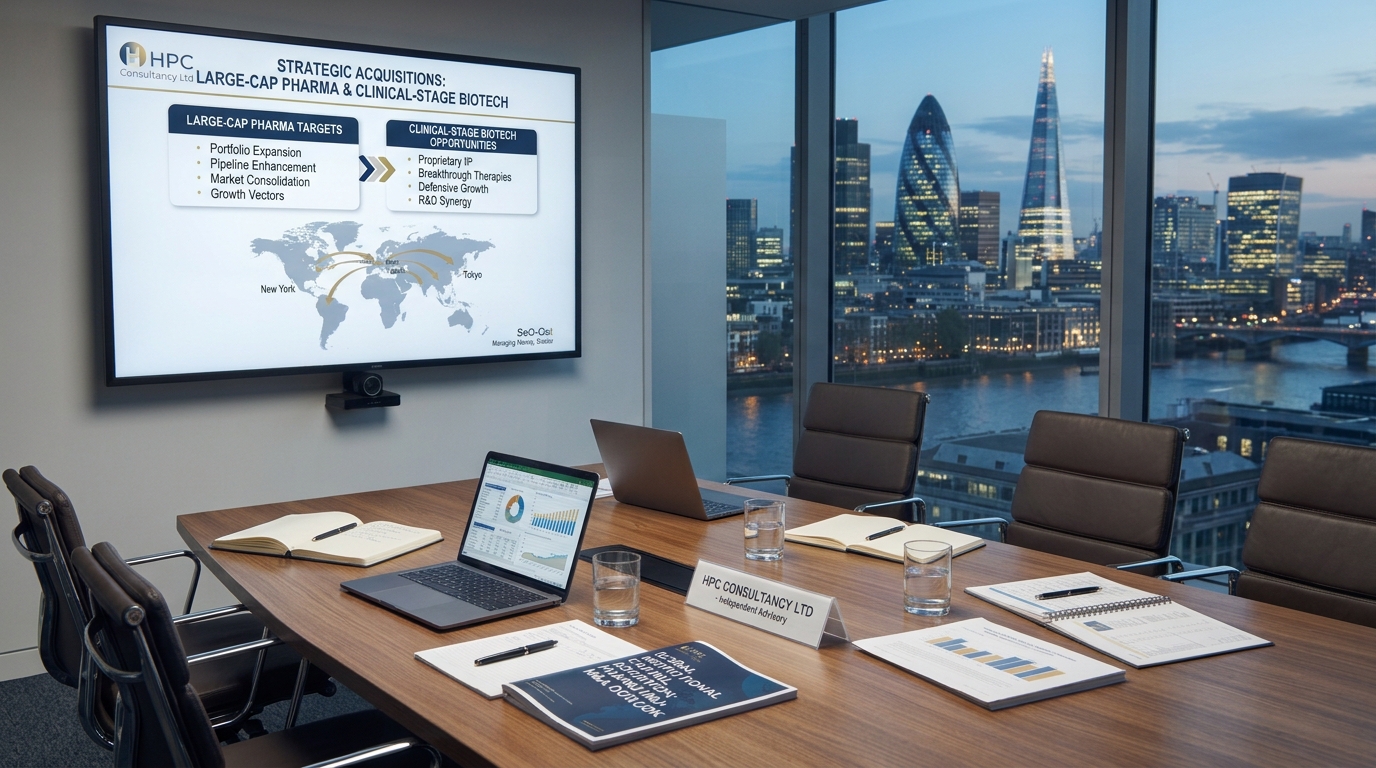
Global institutional capital is rotating decisively toward defensive growth and proprietary intellectual property. While public equity desks monitor oversubscribed pre-IPO and IPO institutional allocations in frontier AI labs, multi-currency Asian bond issuances by US tech hyperscalers, and corporate bond tender offers and liability management exercises, seasoned dealmakers are targeting large-cap pharmaceutical and clinical-stage biotech M&A targets. HPC Consultancy Ltd provides independent commercial advisory, buyer credentialing, and confidential transaction structuring for institutional funds, family offices, and corporate buyers seeking high-value life sciences assets across international markets.
Patent cliffs and institutional appetite for clinical pipelines
Major pharmaceutical groups face approaching patent expirations across flagship revenue lines, creating an urgent commercial need to replenish drug pipelines through targeted acquisitions. Rather than bearing early-stage discovery risk internally, global healthcare leaders and private capital consortia are acquiring late-stage clinical assets with validated Phase II and Phase III trial data. At the same time, AI-native biotech and life sciences spinouts for institutional venture allocation are accelerating target identification and clinical trial design, compressing development timelines and enhancing asset valuations across the United Kingdom, Europe, North America, and Asia.
Global capital flows and cross-border deal structures
Cross-border life sciences transactions increasingly draw on sophisticated institutional financing structures seen across adjacent private markets. Sovereign wealth funds, pension platforms, and private credit managers are deploying capital through diverse mechanisms:
-
Secondary private equity LP stakes and GP-led continuation vehicles allow specialist life sciences funds to extend holding periods for promising clinical assets while delivering liquidity to early backers.
-
Sovereign and quasi-sovereign sukuk issuances and syndicated project finance facilities, alongside cross-border China-Oman sovereign investment vehicles and Belt and Road industrial funds, expand the pool of institutional co-investors backing global healthcare manufacturing and research hubs.
-
Corporate carve-outs of non-core divisions and undervalued public companies for sponsor-led take-private buyouts enable strategic acquirers to unlock focused therapeutic platforms at disciplined entry multiples.
-
Cross-border M&A merger control and EU Foreign Subsidies Regulation filings require experienced regulatory coordination to keep complex multi-jurisdictional pharmaceutical buyouts on schedule.
Why institutional buyers partner with HPC
Executing a cross-border acquisition in large-cap pharmaceuticals or clinical-stage biotechnology demands rigorous scientific vetting, intellectual property verification, and strict transaction confidentiality. HPC connects qualified institutional buyers with vetted sell-side mandates, coordinates specialist technical due diligence, and structures bespoke acquisition terms that protect buyer capital through regulatory milestones.
If your fund, corporate development team, or family office is evaluating large-cap pharmaceutical or clinical-stage biotech M&A targets, contact the HPC advisory team today to review active mandates.
Frequently asked questions for Worldwide investors on large-cap pharmaceutical and clinical-stage biotech acquisitions
1. Why are large-cap pharmaceutical and clinical-stage biotech M&A targets attracting strong institutional demand?
Approaching patent expirations across major drug franchises compel established pharmaceutical groups and private equity sponsors to acquire de-risked clinical pipelines with strong intellectual property protection and high commercial margins.
2. How does HPC assist investors from Worldwide in acquiring pharmaceutical and biotech companies?
HPC provides independent commercial advisory, buyer credentialing, and confidential deal origination, connecting investors from Worldwide with vetted life sciences targets and specialist technical due diligence teams.
3. What role do AI-native biotech and life sciences spinouts for institutional venture allocation play in current deal flow?
AI-native biotech and life sciences spinouts for institutional venture allocation use computational biology to identify novel drug targets faster, making them attractive bolt-on acquisitions for larger pharmaceutical platforms.
4. How do secondary private equity LP stakes and GP-led continuation vehicles support biotech investments?
Secondary private equity LP stakes and GP-led continuation vehicles, exemplified by credit secondaries and fund-level NAV credit facilities following Ares Management's continuation vehicle commitments, give life sciences investors extended capital horizons to reach pivotal clinical readouts.
5. How do outbound sovereign wealth acquisitions in UK and European financial services compare with healthcare capital deployment?
Major institutional moves, such as UK wealth management acquisitions led by the £1.2 billion Mubadala and Centerbridge buyout of Canaccord's UK arm and global private equity firms establishing Dubai DIFC private wealth distribution hubs like Blackstone opening its DIFC office, reflect surging sovereign and private capital liquidity also targeting defensive healthcare assets.
6. What opportunities exist in Saudi healthcare and rehabilitation services M&A alongside global biotech deals?
Regional healthcare consolidation, highlighted by Saudi healthcare and rehabilitation services M&A such as Almasar Alshamil's acquisition of Konoz, creates strong cross-border distribution partnerships for international pharmaceutical companies entering the Gulf.
7. How do oversubscribed pre-IPO and IPO institutional allocations in frontier AI labs affect biotech valuations?
Strong public market appetite, demonstrated by oversubscribed pre-IPO and IPO institutional allocations in frontier AI labs following Anthropic's IPO drawing six-times oversubscription, spills over into computational drug discovery and AI-driven clinical platforms.
8. How do undervalued FTSE 250 public companies for sponsor-led take-private buyouts create life sciences opportunities?
Public market valuation discounts, seen in undervalued FTSE 250 public companies for sponsor-led take-private buyouts and public takeover bids for European retail technology and digital shelf-label providers such as VusionGroup's offer for Pricer, allow sponsors to acquire listed UK and European specialty pharma companies at attractive premiums.
9. How do cross-border M&A merger control and EU Foreign Subsidies Regulation filings affect pharmaceutical buyouts?
Cross-border M&A merger control and EU Foreign Subsidies Regulation filings require early antitrust analysis of overlapping therapeutic pipelines and sovereign funding sources to avoid prolonged regulatory reviews.
10. What financing tools support large-cap pharmaceutical acquisitions amid shifting interest rate expectations?
Acquirers combine corporate bond tender offers and liability management exercises, such as ExxonMobil's cash tender offers for euro-denominated notes, with US Treasury long-dated yield hedging and Federal Reserve rate-path derivatives to lock in predictable debt costs.
11. How do leveraged loan syndication pricing and pulled institutional debt offerings affect biotech buyout financing?
Tighter credit selectivity, seen in leveraged loan syndication pricing and pulled institutional debt offerings such as Citigroup pulling a $400 million UST Global loan on weak demand, makes conservative leverage and structured milestone payments essential in life sciences transactions.
12. How do multi-currency Asian bond issuances and Asia-Pacific trading desk expansion influence cross-border healthcare capital?
Deep regional liquidity, supported by multi-currency Asian bond issuances by US tech hyperscalers following Alphabet raising $3.8 billion across Hong Kong and Singapore dollar debt sales and Asia-Pacific trading desk expansion following Citadel Securities expanding offices in Singapore and Sydney, facilitates multi-currency financing for Asian pharmaceutical buyers.
13. What role do pre-IPO late-stage secondary blocks and Japanese corporate governance activist targets play in Asian life sciences M&A?
Corporate restructuring across Asia, including pre-IPO late-stage secondary blocks in Asian tech and consumer conglomerates and Japanese corporate governance activist targets and conglomerate asset divestitures, unlocks non-core pharmaceutical and medical device subsidiaries for strategic acquirers.
14. How do cross-border supply chain manufacturing facilities in Vietnam, India, and Malaysia support global pharmaceutical production?
Expanding industrial hubs, reflected in cross-border supply chain manufacturing facilities in Vietnam, India, and Malaysia alongside semiconductor packaging, testing, and critical mineral supply contracts, offer cost-efficient active pharmaceutical ingredient and medical device manufacturing capacity.
15. How do cross-border China-Oman sovereign investment vehicles and Belt and Road industrial funds engage in healthcare investments?
Bilateral capital platforms, such as cross-border China-Oman sovereign investment vehicles and Belt and Road industrial funds, co-invest in biomanufacturing parks and regional pharmaceutical distribution infrastructure.
16. What impact do foreign currency intervention thresholds and USD/JPY cross-currency basis swaps have on cross-border biotech deals?
Monitoring foreign currency intervention thresholds and USD/JPY cross-currency basis swaps helps buyers from Worldwide hedge exchange rate exposure when acquiring Japanese or Asian life sciences assets.
17. How do tokenised wholesale bank deposits and 24/7 cross-border settlement rails streamline international M&A closings?
Emerging financial infrastructure, including tokenised wholesale bank deposits and 24/7 cross-border settlement rails, accelerates escrow funding and milestone payouts across international time zones.
18. How does global AI compute infrastructure and hyperscale data centre capacity support clinical-stage biotech?
Expanding compute capacity, driven by global AI compute infrastructure, sovereign cloud partnerships, and semiconductor supply deals, pre-built data centre capacity and high-voltage power interconnection assets, hyperscale AI data centre land parcels and Southeast Asian hydropower capacity, and prepaid corporate energy bond deals to power AI data centres following Alphabet anchoring $3 billion in prepaid energy bonds, underpins large-scale genomic sequencing and molecular simulation.
19. How do corporate carve-outs of non-core UK industrial, engineering, and defence divisions compare with pharmaceutical divestitures?
Similar to corporate carve-outs of non-core UK industrial, engineering, and defence divisions and European defence, dual-use aerospace, and autonomous systems manufacturers, large pharmaceutical groups regularly divest mature drug brands so private equity buyers can revitalize them.
20. What role do Lloyd's of London specialty insurance platforms and London Bridge 2 private capital structures play in clinical trial risk management?
Specialist underwriting, supported by Lloyd's of London specialty insurance platforms and London Bridge 2 private capital structures alongside insurance broker consolidation and capital-light managing general agent platforms across DACH markets, provides tailored clinical trial liability and intellectual property litigation cover.
21. How do bulk annuity pension risk transfer mandates and Solvency II capital rules shape institutional healthcare allocations?
Balance-sheet optimization across insurers, seen in bulk annuity pension risk transfer mandates and longevity reinsurance deals and Solvency II capital treatment for collateralised loan obligation debt tranches, channels long-duration institutional capital into stable, cash-generative pharmaceutical royalties.
22. How do semi-liquid evergreen private market funds expand access to life sciences investments?
Semi-liquid evergreen private market funds for European wealth distribution channels enable private wealth investors to allocate capital into diversified healthcare and late-stage biotech portfolios.
23. How do spot-purchase SME loan portfolios and non-performing loan risk transfers relate to healthcare service financing?
Private credit expertise, demonstrated in spot-purchase SME loan portfolios and non-performing consumer credit books following Azzurro Associates' £77 million acquisition and non-performing loan portfolios and bank balance-sheet risk transfers, supports structured receivables financing for clinics and medical suppliers.
24. How do Australian private credit fund managers and superannuation LP board appointments influence global biotech capital?
Growing private debt allocations, reflected in Australian private credit fund managers and superannuation LP board appointments following Australian Investment Council board shifts toward private debt, provide non-dilutive venture debt to clinical-stage biotechnology companies.
25. What lessons do institutional equity portfolio rotations and non-bank lender warnings offer life sciences investors?
Disciplined risk management, highlighted by institutional equity portfolio rotations into airlines and out of major US money-centre banks following Berkshire Hathaway boosting Delta and trimming Bank of America and non-bank property lender credit risk and central bank macroprudential tightening following RBNZ warnings on non-bank real estate lenders, underscores the value of backing pharmaceutical companies with strong balance sheets.
26. How do Canadian telecom takeover bids and satellite competition assessments illustrate regulatory scrutiny in large-cap M&A?
High-profile transactions, such as Canadian telecom takeover bids and satellite competition assessments following Fiera Capital backing Quebecor's C$31 billion bid for Telus, demonstrate the importance of proactive competition clearance strategies in large-cap pharmaceutical mergers.
27. How do GCC regional initial public offering bookbuilding and sovereign sukuk issuances support regional healthcare expansion?
Active Gulf capital markets, including GCC regional initial public offering bookbuilding and foreign institutional allocations and sovereign and quasi-sovereign sukuk issuances and syndicated project finance facilities, fund hospital networks and biotechnology research campuses.
28. How do energy and infrastructure assets—such as pre-permitted grid-connected battery storage, European gas transmission stakes, LNG offtake agreements, and desalination credit assessments—contrast with pharmaceutical investments?
While real assets like pre-permitted grid-connected battery storage and offshore wind energy assets, European gas transmission infrastructure stakes such as Enagás acquiring EDF's 18% stake in Teréga for €311 million, liquefied natural gas long-term offtake agreements and petrochemical downstream assets, and desalination plant credit risk assessments and water infrastructure resilience offer inflation-linked infrastructure yields, pharmaceutical M&A delivers higher intellectual-property-driven margin upside.
29. How do global maritime security and supply chain shifts—including war-risk marine hull insurance rates and Strait of Hormuz transit rerouting logistics—affect pharmaceutical cold-chain transport?
Shipping route adjustments, driven by war-risk marine hull insurance rates and Strait of Hormuz transit rerouting logistics, require pharmaceutical manufacturers to maintain dual-route air and sea cold-chain logistics for temperature-sensitive biologics.
30. How do master-planned urban development land parcels and hospitality contracts integrate with medical tourism hubs?
Master-planned urban development land parcels and hospitality brand management contracts across the Gulf increasingly incorporate specialized wellness clinics and longevity medicine centres backed by international clinical partners.
31. How do African industrial, mining, and infrastructure trends—such as domestic mineral processing mandates, Southern African mining machinery suppliers, utility-scale wind farm project finance, and Tier-1 critical mineral mining concessions—intersect with global medical supply chains?
Resource and industrial developments across Africa, including domestic mineral processing and local value-addition mandates following 13 African nations restricting raw mineral exports to force local refining, Southern African mining machinery, crushing equipment, and industrial aftermarket suppliers following FLSmidth's acquisition of CE Africa, utility-scale renewable energy and wind farm project finance such as the 900 MW Gulf of Suez III Wind Farm in Egypt, and Tier-1 copper, cobalt, and critical mineral mining concessions for strategic acquisition, secure raw materials essential for diagnostic imaging and medical devices.
32. How do African sovereign debt, rail privatisation, telecom networks, DFI blended finance, commercial warehousing, and CEPA tariff schedules support regional pharmaceutical distribution?
Expanding logistics and financial infrastructure across Africa, encompassing sovereign eurobond yield spreads and local-currency treasury bill auctions, private rail corridor concessions and port logistics infrastructure privatisation, pan-African telecommunications towers, fibre networks, and mobile money platforms, Development Finance Institution blended-finance guarantees and political risk insurance, commercial real estate and industrial warehousing in Nairobi, Lagos, and Johannesburg, and cross-border Comprehensive Economic Partnership Agreement tariff schedules, lowers distribution barriers for international pharmaceutical companies entering African markets.
33. How does commercial real estate debt restructuring and prime logistics warehouse refinancing benefit pharmaceutical distributors?
Commercial real estate debt restructuring and prime logistics warehouse refinancing enables cold-storage operators and pharmaceutical wholesalers to modernize temperature-controlled distribution facilities at competitive financing rates.
34. What due diligence steps are critical when evaluating a clinical-stage biotech acquisition target?
Buyers audit raw clinical trial datasets, regulatory correspondence with the FDA or EMA, patent expiration timelines, freedom-to-operate analyses, and chemistry, manufacturing, and controls scalability.
35. How are contingent value rights used to bridge valuation gaps in biotech M&A?
Contingent value rights tie a portion of the purchase price to future regulatory approvals or commercial sales milestones, protecting buyer capital if a clinical programme encounters delays.
36. What intellectual property protections must be verified before acquiring a pharmaceutical company?
Legal teams verify composition-of-matter patents, method-of-use claims, patent term extensions, and exclusivity periods across major global jurisdictions to ensure durable market protection.
37. How does HPC protect confidentiality for Worldwide investors reviewing off-market life sciences targets?
HPC enforces strict staged non-disclosure agreements and buyer credential verification before releasing confidential clinical data rooms, patent schedules, or seller identities.
38. What distinguishes acquiring an established large-cap pharmaceutical unit from buying a clinical-stage biotech firm?
Established pharmaceutical units generate immediate cash flow from approved products, whereas clinical-stage biotech targets offer higher capital appreciation potential tied to upcoming trial readouts and regulatory approvals.
39. How do regulatory designations like Orphan Drug or Breakthrough Therapy status enhance target valuations?
Special regulatory designations accelerate review timelines, reduce clinical development costs, and grant extended market exclusivity upon approval, significantly boosting net present value.
40. Can investors from Worldwide co-invest alongside specialist healthcare venture or buyout funds?
Yes, HPC structures syndicate and co-investment arrangements enabling family offices and corporate buyers from Worldwide to partner with experienced life sciences sector specialists.
41. What manufacturing risks should acquirers assess in biologics and cell therapy companies?
Due diligence examines batch consistency, contract development and manufacturing organization agreements, supply chain redundancy, and compliance with Good Manufacturing Practice standards.
42. How do drug pricing and reimbursement frameworks affect post-acquisition revenue forecasts?
Advisors model payer reimbursement coverage, health technology assessment outcomes, and regional pricing agreements across the US, Europe, and emerging markets to validate commercial projections.
43. What tax structures optimize cross-border pharmaceutical acquisitions for investors from Worldwide?
Tax specialists structure intellectual property holding entities, research and development tax credit claims, and double-taxation treaty pathways to maximize after-tax returns.
44. How long does a typical cross-border biotech or pharmaceutical acquisition take to close?
Transactions generally require between three and six months from initial term sheet signing through scientific due diligence, antitrust filings, and final closing.
45. What post-merger integration steps preserve scientific talent after acquiring a biotech firm?
Retaining lead principal investigators, aligning milestone incentives, and preserving agile laboratory autonomy prevent key research personnel attrition following ownership changes.
46. How do royalty monetization deals work as an alternative to full corporate buyouts?
Investors acquire a percentage of future net product sales in exchange for upfront non-dilutive capital, generating predictable cash yields without assuming operational management responsibilities.
47. What red flags does HPC screen for during preliminary life sciences target vetting?
Advisors screen out targets with weak patent enforceability, unblinded or statistically underpowered trial designs, unresolved FDA clinical holds, or severe single-supplier bottlenecks.
48. Can corporate buyers from Worldwide acquire regional licensing rights instead of global equity?
Yes, territorial licensing and joint-venture agreements allow pharmaceutical companies from Worldwide to commercialize late-stage drugs within designated domestic or regional markets.
49. How does HPC benchmark valuation multiples for clinical-stage biotech targets?
HPC evaluates comparable precedent transactions, risk-adjusted net present value models across clinical phases, and peak annual sales projections to establish disciplined pricing.
50. How can investors and corporate development leaders from Worldwide initiate a confidential life sciences M&A mandate with HPC?
Principals, fund managers, and corporate executives from Worldwide can contact the HPC advisory team directly to verify credentials and review active pharmaceutical and biotech acquisition opportunities.