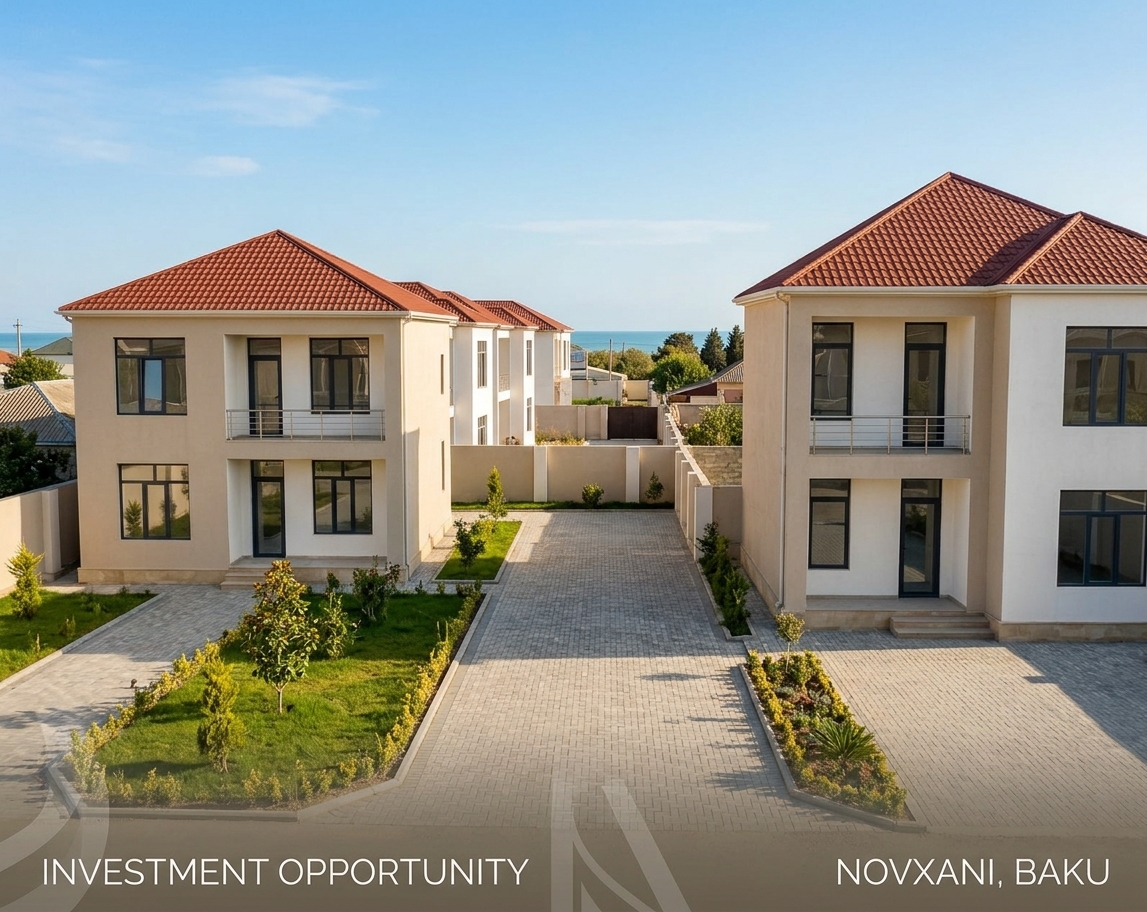
Real estate investors and developers are turning toward Baku's coastal and suburban corridors as rising land values and steady housing demand support new-build developments across Azerbaijan. HPC Consultancy Ltd is presenting a residential housing development opportunity in Novxani, Baku, spanning 72 sot (approximately 288 marla) with plans for roughly 20 residential villas. Priced on a project valuation of AZN 2 million AZN (approx $1m), the development targets estimated gross revenue of up to AZN 4 million upon completion.
Site scale and active construction progress
Unlike raw land parcels that face lengthy early engineering delays, this Novxani site already has substantial construction underway:
-
Three luxury houses of 168 m² each are completed and ready for sale or occupancy
-
Four houses of 206 m² each are at an advanced stage with plastering and internal structural work finished
-
Seven further houses have monolithic reinforced concrete foundations completed
-
Master plans cover approximately 20 residential villas across 72 sot, averaging 3 sot per villa
Market fundamentals and financial potential in Baku
Novxani sits in a growing suburban residential corridor near Baku, giving buyers exposure to local demand for modern family housing alongside longer-term capital growth. With completed homes ready for market and foundational work already in place across the next phase, an incoming buyer can pursue early unit sales while finishing the remaining villas toward the projected AZN 4 million gross revenue target.
Structured acquisition through HPC
HPC acts as reseller for this Novxani development, coordinating buyer vetting, local ownership structuring, and direct negotiations under confidentiality. Because foreign buyers hold land in Azerbaijan through a locally registered company, our team helps international buyers align their acquisition structure and review project records.
If your fund, development firm, or family office is looking for a residential development project in Baku, contact the HPC advisory team today to review the project details.
Frequently asked questions for Worldwide investors on Baku residential development and global markets
1. What is the residential housing development opportunity in Novxani, Baku offered through HPC?
The project is a residential housing development spanning 72 sot (approximately 288 marla) in Novxani, Baku, planned for roughly 20 residential villas, offered on a project valuation of AZN 2 million, with estimated gross revenue of up to AZN 4 million upon completion.
2. How much construction progress has already been completed at the Novxani site?
Three luxury houses of 168 m² each are completed and ready for sale or occupancy, four houses of 206 m² each have finished plastering and internal structural work, and seven additional houses have monolithic reinforced concrete foundations in place.
3. How does HPC assist investors from Worldwide in acquiring the Baku residential project?
HPC acts as reseller and commercial advisor for investors from Worldwide, managing buyer credentialing, confidentiality agreements, local corporate entity structuring in Azerbaijan, and direct seller negotiations.
4. Why do investors from Worldwide look at suburban Baku developments alongside global institutional markets?
Investors from Worldwide balance public market exposure with tangible, mid-stage residential projects where existing construction reduces early development delays and offers clear unit sales potential.
5. How do UK National Wealth Fund defence technology and industrial manufacturing co-investment mandates compare with international property deals?
While UK National Wealth Fund defence technology and industrial manufacturing co-investment mandates channel public-private capital into domestic strategic sectors, international residential projects provide direct exposure to emerging urban housing demand.
6. How do UK pension scheme buyouts, bulk annuity risk transfers, and longevity reinsurance affect institutional capital flows?
Active UK pension scheme buyouts, bulk annuity risk transfers, and longevity reinsurance deals shift long-term liabilities onto insurers, prompting institutional asset managers to seek diversified real assets and private credit.
7. What do FTSE 250 public-to-private buyouts and undervalued investment trust share buybacks signal for equity investors?
Trends in FTSE 250 public-to-private buyouts and undervalued investment trust share buybacks show sponsors and boards acting decisively when listed valuations trade below intrinsic asset value.
8. Why are grid-connected battery storage, offshore wind, and data centre power interconnection assets attracting infrastructure funds?
Grid-connected battery storage, offshore wind, and data centre power interconnection assets address acute electricity bottlenecks and deliver long-term contracted cash flows.
9. How do UK private credit direct lending facilities and distressed corporate debt restructuring shape financing terms?
Developments in UK private credit direct lending facilities and distressed corporate debt restructuring encourage sponsors to maintain conservative leverage and clear asset backing.
10. How do cross-border transatlantic M&A advisory, technology transactions, and corporate carve-outs support portfolio growth?
Cross-border transatlantic M&A advisory, technology transactions, and corporate carve-outs help international companies expand market reach and unlock value from non-core divisions.
11. How do UK wealth management consolidation and sovereign-backed private equity co-investments expand syndicate capacity?
Momentum in UK wealth management consolidation and sovereign-backed private equity co-investments creates larger advisory platforms capable of co-investing across international real estate and corporate deals.
12. What compliance priorities arise from FCA operational resilience, cyber risk supervision, and ESG reporting compliance?
FCA operational resilience, cyber risk supervision, and ESG reporting compliance require regulated asset managers and service providers to maintain strong governance, data security, and transparent disclosures.
13. How do UK gilt yield curve positioning and Bank of England terminal rate hedging affect cross-border buyers?
Tracking UK gilt yield curve positioning and Bank of England terminal rate hedging helps investors from Worldwide manage funding costs and currency exposure on international acquisitions.
14. How do secondary private equity LP stakes and GP-led continuation vehicles support portfolio liquidity?
Secondary private equity LP stakes and GP-led continuation vehicles provide liquidity options for investors while allowing sponsors to hold high-performing assets longer.
15. How do the EU Sovereign Tech Equity Fund (€50bn) and European Quantum Act co-investment frameworks shape European innovation?
Proposals around the EU Sovereign Tech Equity Fund (€50bn) and European Quantum Act co-investment frameworks aim to close Europe's scale-up funding gap by pairing public seed capital with private institutional investors.
16. What do German industrial, defence, and technology infrastructure sovereign-backed acquisitions signal for Europe?
Major initiatives such as German industrial, defence, and technology infrastructure sovereign-backed acquisitions highlighted by QIA and Brookfield exploring a $16.5bn investment show large sovereign and institutional platforms targeting strategic European industrial capacity.
17. Why are European data centre capacity, gigawatt-scale power partnerships, and high-voltage grid assets in high demand?
European data centre capacity, gigawatt-scale power partnerships, and high-voltage grid assets are essential to support cloud computing and artificial intelligence workloads across the continent.
18. How do European defence, dual-use aerospace, and autonomous systems equity financing mandates attract capital?
Rising European security budgets drive institutional allocations into European defence, dual-use aerospace, and autonomous systems equity financing.
19. What drives transatlantic M&A dealmaking and European corporate acquisitions of US technology and healthcare assets?
Transatlantic M&A dealmaking and European corporate acquisitions of US technology and healthcare assets enable European groups to acquire commercial scale and advanced intellectual property in North America.
20. How do European Investment Bank energy autonomy and InvestEU life-sciences co-financing support capital-intensive sectors?
European Investment Bank (EIB) energy autonomy and InvestEU life-sciences co-financing reduce early funding risk and crowd in private institutional co-investors.
21. How do insurance broker consolidation, Solvency II capital treatment, and EU Foreign Subsidies Regulation filings affect deal execution?
Insurance broker consolidation and capital-light managing general agent (MGA) platforms, Solvency II capital treatment for collateralised loan obligation (CLO) debt tranches, and cross-border M&A merger control and EU Foreign Subsidies Regulation filings shape how European institutions structure transactions and manage regulatory clearance.
22. How do semi-liquid evergreen private market funds and tokenised fund structures expand investor access?
Semi-liquid evergreen private market funds and tokenised fund structures allow wealth platforms and private clients to access private equity and real asset strategies with improved liquidity management.
23. What do Hong Kong and Malaysian IPO bookbuilding, REIT listings, and spin-off introductions show about Asian capital markets?
Activity in Hong Kong and Malaysian IPO bookbuilding, REIT listings, and spin-off introductions demonstrates resilient regional investor demand for income-producing real estate and corporate carve-outs.
24. How do Asia-Pacific private equity pre-IPO growth blocks and sponsor partial exits create liquidity?
Asia-Pacific private equity pre-IPO growth blocks and sponsor partial exits give institutional buyers entry into established regional leaders ahead of public market listings.
25. Why are hyperscale AI data centre equity raises and Southeast Asian power generation capacity critical in Asia?
Hyperscale AI data centre equity raises and Southeast Asian power generation capacity address fast-growing regional compute demand where grid reliability and power availability determine project viability.
26. How does US export control licensing compliance for advanced AI chip procurement in Singapore and Malaysia affect regional operators?
Strict adherence to US export control licensing compliance for advanced AI chip procurement in Singapore and Malaysia is essential for data centre operators and hardware buyers across Southeast Asia.
27. How do cross-border logistics, container shipping, and supply chain manufacturing acquisitions in India and ASEAN reshape trade?
Cross-border logistics, container shipping, and supply chain manufacturing acquisitions in India and ASEAN reflect global companies diversifying production bases and transport corridors.
28. How do Asian sovereign wealth fund and APAC family office direct co-investment mandates influence global transactions?
Asian sovereign wealth fund and APAC family office direct co-investment mandates bring patient, flexible capital into global infrastructure, real estate, and private credit syndicates.
29. How do tokenised wholesale bank deposits, semiconductor supply contracts, Japanese activist targets, and USD/JPY basis swaps affect Asian finance?
Developments across tokenised wholesale bank deposits, digital securities exchanges, and 24/7 settlement rails, semiconductor packaging, testing, and critical mineral supply contracts, Japanese corporate governance activist targets and conglomerate asset divestitures, and foreign currency intervention thresholds and USD/JPY cross-currency basis swaps modernize settlement while managing supply and currency risks.
30. What do African private credit facilities and larger-ticket institutional debt syndications indicate for regional financing?
Growth in African private credit facilities and larger-ticket institutional debt syndications gives mid-market and infrastructure businesses flexible non-bank growth capital.
31. How do Gulf-Africa bilateral infrastructure, port logistics, and industrial corridor co-investments connect regions?
Gulf-Africa bilateral infrastructure, port logistics, and industrial corridor co-investments link Gulf sovereign and corporate capital with high-growth African trade gateways.
32. Why are Tier-1 copper, cobalt, and critical mineral mining concessions for energy transition supply chains attracting strategic buyers?
Tier-1 copper, cobalt, and critical mineral mining concessions for energy transition supply chains provide essential raw materials for global electrification and battery manufacturing.
33. How do pan-African fintech, sovereign eurobond spreads, Mission 300 power finance, and DFI guarantees support African growth?
Expansion in pan-African fintech, cross-border remittance infrastructure, and mobile money platforms alongside tracking sovereign eurobond yield spreads and domestic local-currency treasury bill auctions, utility-scale renewable energy, green hydrogen, and Mission 300 power project finance, and Development Finance Institution (DFI) blended-finance guarantees and political risk insurance strengthens financial inclusion and bankable infrastructure.
34. How do pan-African telecommunications towers, commercial warehousing in Nairobi, Lagos, and Johannesburg, and GDR integration support scale?
Pan-African telecommunications towers and fibre-optic network acquisitions, commercial real estate and industrial warehousing in Nairobi, Lagos, and Johannesburg, and cross-border stock exchange settlement and Global Depositary Receipt (GDR) integration build the physical and capital-market backbone for regional enterprises.
35. What do outbound Gulf sovereign wealth acquisitions in European industrial, defence, and AI infrastructure signal for global markets?
Major moves such as outbound Gulf sovereign wealth acquisitions in European industrial, defence, and AI infrastructure led by QIA and Brookfield's $16.5bn German investment talks confirm the scale of Gulf institutional capital deploying into strategic European sectors.
36. How do Gulf sovereign wealth principal investing in gigawatt-scale UK and European data centre joint ventures shape digital infrastructure?
Gulf sovereign wealth principal investing in gigawatt-scale UK and European data centre joint ventures provides long-term equity for energy-intensive compute campuses.
37. How do GCC domestic M&A and mid-market corporate acquisitions backed by sovereign-linked platforms and private equity drive regional consolidation?
GCC domestic M&A and mid-market corporate acquisitions backed by sovereign-linked platforms and private equity help regional champions scale across logistics, healthcare, and industrial services.
38. How do global sukuk liquidity, GCC IPO bookbuilding, LNG offtake agreements, and war-risk marine hull insurance affect Gulf trade?
Monitoring global sukuk secondary-market liquidity and sovereign Islamic bond spreads, GCC regional initial public offering (IPO) bookbuilding and foreign institutional allocations, liquefied natural gas (LNG) long-term offtake agreements and petrochemical downstream assets, and war-risk marine hull insurance rates and Strait of Hormuz transit rerouting logistics helps investors manage fixed-income, energy, and maritime transport risks.
39. How do intra-GCC co-investment vehicles, localised defence manufacturing, and master-planned urban land parcels support diversification?
Intra-GCC sovereign wealth co-investment vehicles and cross-border industrial alliances, localised defence manufacturing and renewable energy joint ventures in Saudi Arabia and the UAE, and master-planned urban development land parcels and hospitality brand management contracts anchor non-oil economic expansion across the Gulf.
40. How do hyperscaler off-balance-sheet debt issuances and private credit financing for AI data centre build-outs work?
Hyperscaler off-balance-sheet debt issuances and private credit financing for AI data centre build-outs allow technology leaders to fund massive compute expansion while preserving corporate balance-sheet flexibility.
41. What drives US enterprise AI and technology M&A buyouts and post-IPO institutional portfolio rotations?
US enterprise AI and technology M&A buyouts and post-IPO institutional portfolio rotations reflect disciplined valuation reassessment as investors focus on sustainable cash flows and enterprise adoption.
42. How do US life-sciences, clinical-stage biotech, cold-chain logistics buyouts, and regional broadband M&A attract private equity?
US life-sciences, clinical-stage biotech, and cold-chain logistics private equity buyouts alongside US regional broadband and digital infrastructure M&A backed by federal grants combine defensive demand with public-private infrastructure co-funding.
43. How do Australian superannuation fund direct infrastructure allocations and Australian data centre auction platforms shape Oceania deals?
Australian superannuation fund direct infrastructure allocations and APRA regulatory compliance alongside Australian data centre, industrial real estate, and commercial asset auction platforms channel deep domestic pension pools into scalable real assets.
44. How do US Treasury yield hedging, asset manager consolidation, Latin American private markets, and credit secondaries influence global allocators?
US Treasury long-dated yield hedging, Federal Reserve rate-path derivatives, and active fixed-income inflows, asset manager distribution consolidation and retirement drawdown product mandates, Latin American private markets LP-GP deal sourcing and direct lending allocations, and credit secondaries and single-asset GP-led continuation vehicles show how global investors manage interest rates, distribution, and liquidity.
45. Can foreign investors from Worldwide legally acquire residential development land in Baku, Azerbaijan?
Foreign individuals cannot hold freehold land directly in their personal name in Azerbaijan, so investors from Worldwide acquire land through an Azerbaijan-registered corporate entity, which HPC helps structure.
46. How does the average plot size of 3 sot per villa work within the 72-sot master plan in Novxani?
The 72-sot site accommodates approximately 20 residential villas averaging 3 sot per plot, leaving dedicated space for internal access roads and shared residential infrastructure.
47. Can an incoming buyer from Worldwide sell the three completed 168 m² villas immediately after acquisition?
Yes, the three fully completed 168 m² luxury houses are ready for immediate sale or occupancy, allowing the buyer to generate early cash flow while completing the remaining phases.
48. What financial upside does the Novxani project target upon full completion?
Acquired at the AZN 2 million project valuation, the project targets up to AZN 4 million in estimated gross revenue once all 20 villas are completed and sold.
49. How does HPC verify title, construction permits, and engineering status for buyers from Worldwide?
HPC coordinates full access to land title extracts, municipal building approvals, architectural plans, and site inspection records under confidentiality before transaction closing.
50. How can an investor or developer from Worldwide contact HPC to enquire about the Novxani development?
Principals, real estate funds, and family offices from Worldwide can contact the HPC advisory team directly to sign confidentiality terms and receive the complete project dossier.