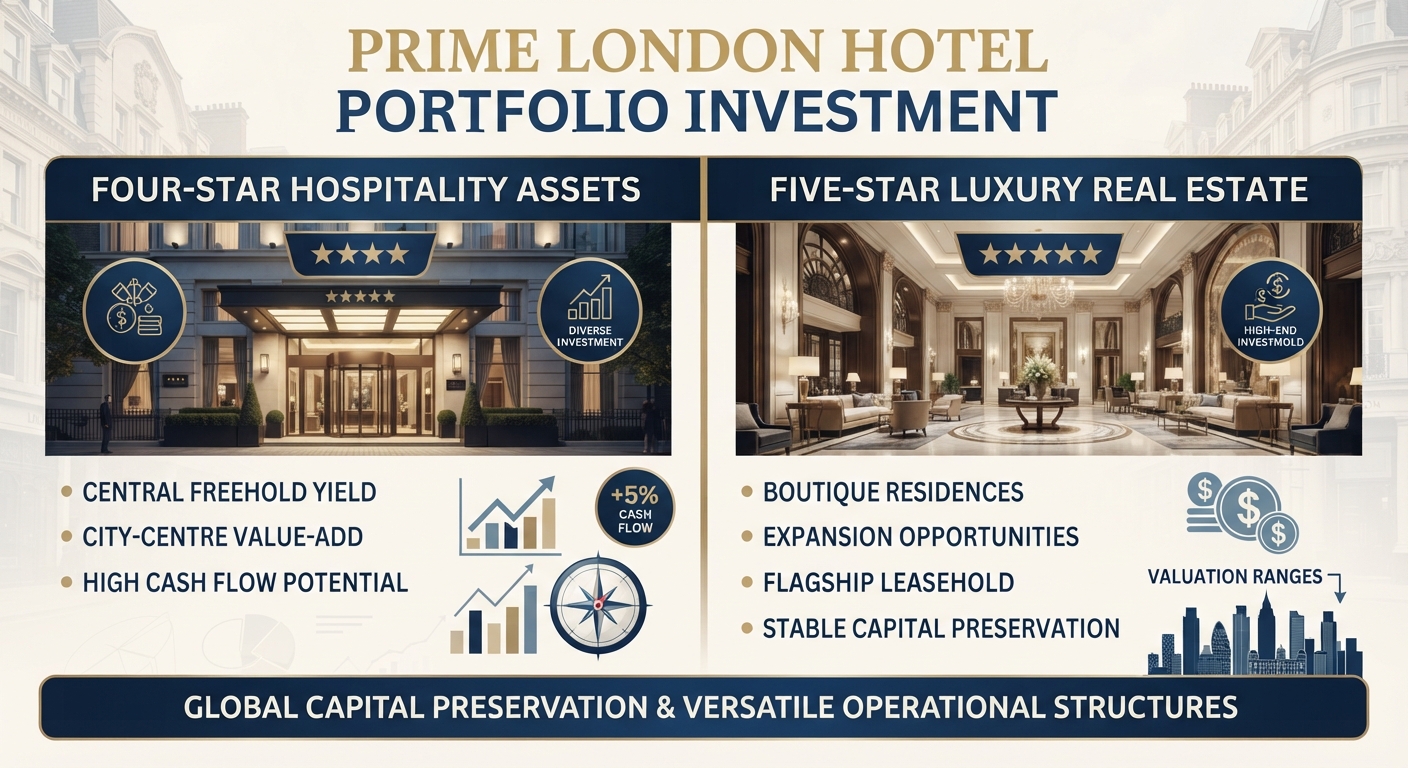
Acquiring high-value hospitality real estate in central London demands access to off-market opportunities and discreet commercial transaction frameworks. Through our trusted HPC partner network, institutional investors, family offices, and private equity funds gain confidential entry to a curated pipeline of prime hotel properties in key capital locations.
Prime Four-Star Hotel Portfolio Investments
Four-star hospitality assets across prime London central districts offer versatile operational structures and strong capital growth potential.
-
A 136-room central property with freehold tenure offers optional management operator structures and an attractive initial yield profile.
-
A 100-room city-centre hotel featuring leasehold tenure presents clear value-add potential through planned room refurbishments yielding over 5%.
-
A compact 50-room freehold operational asset generates high cash flow yields touching 9% with versatile operating conditions.
-
A mid-sized 189-room central hotel held under complete freehold tenure provides stable long-term yields at a valuation of £77.77m.
Luxury Five-Star Hospitality Real Estate
Five-star luxury hotels and branded residential assets in prime London deliver premier positioning for global capital preservation.
-
A boutique 53-room luxury hotel with six private residences holds leasehold tenure, yielding nearly 6.9% at a £65.65m valuation.
-
An expansive 150-room hotel asset includes immediate planning scope to add 11 extra keys for enhanced asset valuation.
-
A flagship 151-room luxury property with 7 suites and a two-bedroom residence offers a long 109-year leasehold interest valued at £151.5m.
-
A premier 170-room central London hotel featuring unencumbered freehold tenure stands valued at £212.1m with a stable 4.5% yield.
Structured Acquisition Protocols and Confidentiality
Executing high-value hospitality acquisitions in competitive London markets requires rigorous confidentiality protocols to protect both buyer and seller interests.
-
Transactions operate under strict non-disclosure frameworks, concealing specific property names and asset addresses during initial reviews.
-
Detailed property dossiers and full identity disclosures are released upon receipt of a formal Letter of Intent prior to direct principal meetings.
-
Tailored advisory support accommodates acquisitions both with existing operator contracts or under vacant possession for custom brand deployment.
Frequently Asked Questions (FAQs) for Worldwide Investors
1. How can Worldwide investors access off-market hotel assets in central London?
Worldwide investors gain confidential access to prime central London hospitality assets through our trusted HPC partner network.
2. What level of confidentiality is maintained during the hotel acquisition process?
Transactions operate under strict confidential dossiers that conceal specific street addresses and brand names until formal protocols are completed.
3. What is included in the stated asset prices within the portfolio?
All indicated property prices transparently include standard professional advisory and transaction fees set at 1%.
4. Are these central London hotels offered with or without operational management?
Investors can acquire these hospitality assets either with existing third-party operators in place or on a vacant possession basis.
5. What are the key details of the 136-room four-star hotel asset?
Located in the city centre under absolute freehold tenure, this 136-room property offers a 3% yield profile.
6. What value-add opportunities exist for the 100-room four-star hotel?
This property features 100 rooms, of which 47 require refurbishment, operating under leasehold tenure with a strong 5.3% yield.
7. What is the yield profile of the compact 50-room freehold hotel?
This boutique 50-room (108 guest capacity) freehold operational asset delivers an exceptional cash flow yield of 9%.
8. What is the valuation of the mid-sized 189-room central London hotel?
The 189-room freehold property provides stable long-term returns with a 3.77% yield at a fixed valuation of 77.77 million pounds.
9. What are the acquisition metrics for the boutique luxury hotel with residences?
This five-star property comprises 53 rooms and 6 private residences under leasehold ownership, yielding nearly 6.9% at 65.65 million pounds.
10. Which luxury hotel asset offers immediate room expansion potential?
A central five-star property featuring 150 existing rooms includes approved planning scope to add 11 extra keys for enhanced valuation.
11. What lease tenure applies to the flagship 151-room luxury property?
Priced at 151.5 million pounds with a 3% yield, this flagship 151-room hotel (including 7 suites and a residential unit) is held on a 109-year lease.
12. What is the valuation and yield of the unencumbered 170-room luxury hotel?
Valued at 212.1 million pounds, this premier 170-room central London hotel features absolute freehold tenure and a stable 4.5% yield.
13. What document must Worldwide investors submit before viewing full property data?
Investors must issue a formal Letter of Intent (LOI) prior to direct principal meetings to unlock complete asset data.
14. How does the HPC partner network assist Worldwide family offices?
The network offers tailored acquisition advisory, confidential deal-flow matching, and structured transaction management for family offices.
15. Do these hospitality assets accommodate private equity investment strategies?
Yes, the portfolio includes options ranging from value-add refurbishment plays to stable core-plus freehold cash-flowing assets.
16. What legal ownership structures are available across the portfolio?
Available structures include absolute freehold ownership, long-term leasehold interests exceeding 100 years, and operational leasehold regimes.
17. How do investors verify the financial performance of these confidential hotels?
Comprehensive operational financials, occupancy rates, and average daily rates (ADR) are disclosed directly following LOI submission.
18. Are these hotel investments suitable for institutional funds based in Worldwide?
Yes, large-scale luxury properties valued above 150 million pounds provide institutional-grade capital preservation and scale.
19. Can foreign buyers execute transactions smoothly through this network?
Our HPC partner network guides international buyers through UK real estate compliance, legal frameworks, and cross-border settlement.
20. What is the typical room count range for the available hotels?
Properties range from intimate boutique operations of 50 rooms up to grand multi-key luxury flagships exceeding 180 rooms.
21. How are property viewings and principal meetings arranged?
Meetings with principals or authorized representatives are coordinated confidentially after the Letter of Intent is approved.
22. What distinguishes freehold ownership from leasehold properties in London?
Freehold grants absolute perpetual ownership of both building and land, whereas leasehold provides long-term usage rights for a specified duration.
23. What value growth can be expected from refurbishing unmodernised rooms?
Renovating unmodernised inventory (such as the 47 rooms in the 100-room asset) allows investors to drive higher ADR and capital appreciation.
24. How do branded residential components enhance five-star hotel valuations?
Integrating private residences alongside luxury hotel rooms diversifies revenue streams and attracts high-net-worth buyers.
25. What role do professional operators play if retained post-acquisition?
Retained operators manage daily hospitality workflows, staffing, and marketing while investors secure passive yields.
26. Can Worldwide investors acquire these assets under vacant possession?
Yes, properties can be acquired with or without existing operational management according to investor preference.
27. What safety measures protect seller identities in these dossiers?
All listings remain anonymous during initial marketing phases to prevent market speculation and protect commercial sensitivity.
28. How does central London tourism demand support these hotel yields?
Consistent corporate, luxury leisure, and international tourism inbound traffic maintains robust occupancy levels across central London zones.
29. Are financing advisory services available for these capital-intensive acquisitions?
Our partner network connects qualified buyers with premier debt advisory and banking structures tailored to UK hospitality.
30. What is the significance of a 109-year leasehold term?
A 109-year term provides long-term security for institutional lending and asset planning without near-term lease renewal pressures.
31. How quickly can a transaction move from LOI to completion?
Transaction velocity depends on due diligence depth, but pre-vetted dossiers enable accelerated closing timelines for prepared buyers.
32. What distinguishes a four-star rating from a five-star rating in this portfolio?
Five-star assets feature extensive luxury amenities, fine dining, spa facilities, and premium suite configurations catering to ultra-high-net-worth guests.
33. How does currency fluctuation affect Worldwide investments in UK real estate?
Investing in British pound-denominated prime London real estate offers a stable hedge and hard-currency capital preservation.
34. What guarantees do buyers have regarding the accuracy of portfolio data?
Data presented in the confidential dossiers is verified by asset owners and released formally upon execution of confidentiality agreements.
35. Can syndicates of investors pool resources for these hotel acquisitions?
Yes, our advisory team assists in structuring multi-party equity syndicates and joint ventures for larger capital requirements.
36. What ongoing management support does HPC provide after purchase?
HPC acts as a continuous commercial advisor, bridging investor strategy with local asset management and operational oversight.
37. Are there zoning restrictions on adding rooms to central London hotels?
Adding rooms requires careful planning navigation, making assets with existing expansion scope (such as the 11-room addition property) highly desirable.
38. How do high-yielding assets (such as the 9% yield property) achieve their returns?
Higher yields often reflect operational optimization potential, smaller capital entry points, or specific lease structures in dynamic locations.
39. What are the typical closing costs associated with UK hotel acquisitions?
Closing costs generally include stamp duty land tax (SDLT), legal fees, structuring costs, and advisory commissions.
40. Why are off-market hotel transactions preferred by institutional buyers?
Off-market deals prevent public brand exposure, maintain staff stability, and allow discreet negotiations without competitive bidding wars.
41. How does hotel real estate compare to commercial office spaces in London?
Hotels offer dynamic daily room rate adjustments, providing a robust inflation hedge compared to traditional long-lease office structures.
42. What environmental and sustainability standards apply to these London hotels?
Modernizing older London hotels often incorporates ESG upgrades to reduce carbon footprints and meet tightening UK building efficiency regulations.
43. How do luxury hotel residences command premium valuations?
Branded residences combine hotel-grade concierge services with residential privacy, commanding top-tier square footage pricing.
44. What happens during the principal meeting following LOI submission?
Investors review audited accounts, inspect physical asset conditions, and discuss precise deal mechanics directly with decision-makers.
45. Can investors rebrand these hotels under international flags?
Properties acquired with vacant possession or flexible operator agreements allow seamless rebranding to global luxury hospitality chains.
46. What minimum capital threshold is required to enter this hotel portfolio?
Entry points range from approximately 22 million pounds for compact operational assets up to over 212 million pounds for flagship luxury real estate.
47. How does location within central London influence hotel performance?
Proximity to major financial districts, cultural landmarks, and West End retail hubs ensures steady, year-round international demand.
48. Are there opportunities for portfolio acquisition rather than single assets?
Investors can curate multi-asset portfolios across the four-star and five-star brackets to diversify risk across London's hospitality sector.
49. How do tax efficiencies apply to corporate hotel ownership structures in the UK?
Structuring acquisitions through UK corporate vehicles or offshore holding entities can optimize holding and capital gains tax positions.
50. How can Worldwide business leaders initiate their hotel acquisition mandate?
Leaders can outline their investment criteria, target yields, and capital parameters to our HPC partner network to review active confidential dossiers.