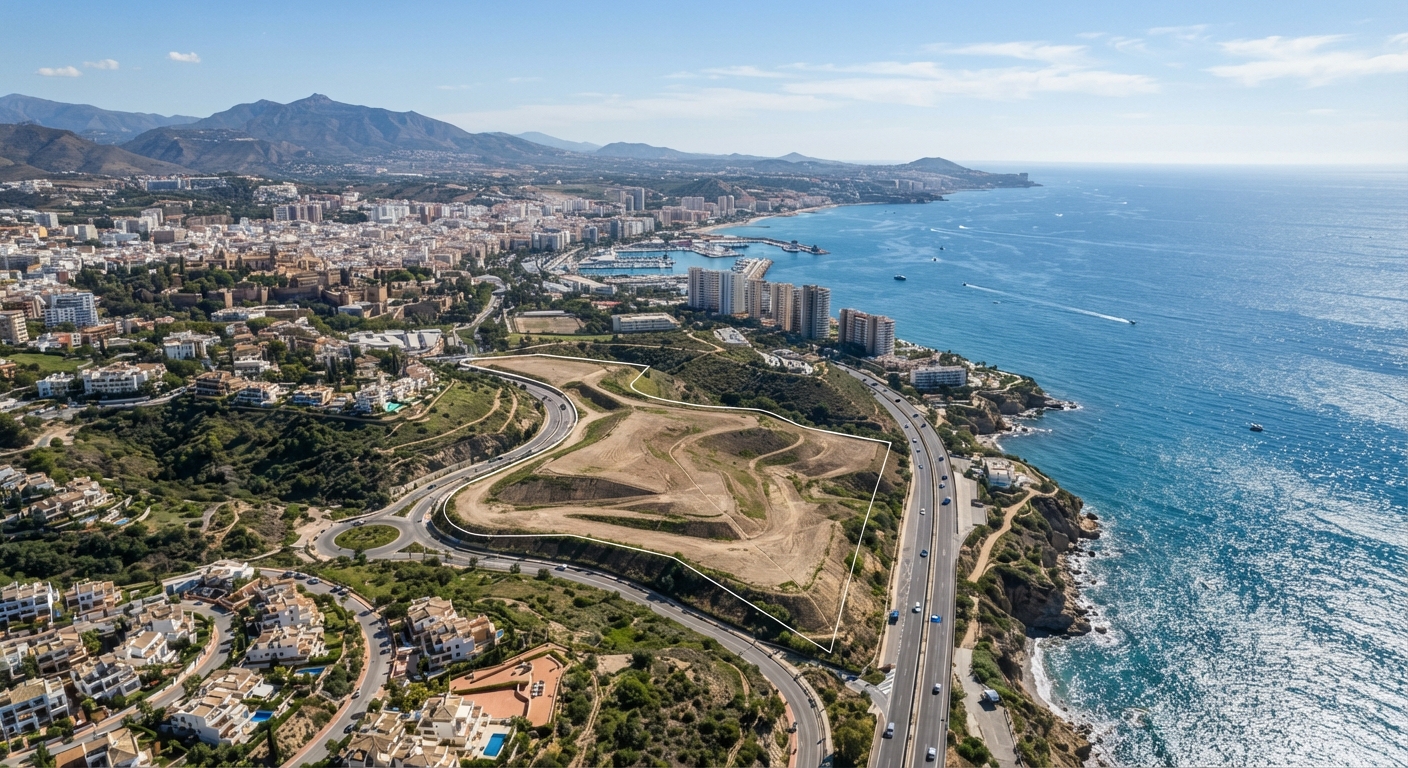
Institutional real estate developers, private equity funds, and sovereign family offices are actively seeking large-scale land parcels across southern Europe's strongest growth corridors. Málaga has established itself as the economic engine of Andalusia, recording annual residential price growth exceeding 13.8 percent alongside sustained international corporate relocation and year-round tourism demand. HPC Consultancy Ltd presents an exclusive sell-side mandate for a premier strategic development site in Málaga, Andalusia, offering 64,946 m² (approximately 6.49 hectares or 16.05 acres) at a guide price of €92,650,000, equating to €1,427 per m² of land area.
Site scale and regional market fundamentals
Large contiguous land parcels of nearly 6.5 hectares are increasingly scarce along the narrow coastal strip between the Mediterranean Sea and the Baetic mountain range. While built residential and branded residence benchmarks across Málaga province surpass €3,842 per m², acquiring strategic land at €1,427 per m² provides substantial margin potential for institutional developers.
-
Strategic location in Málaga, Andalusia provides direct proximity to Málaga-Costa del Sol International Airport, high-speed AVE rail links to Madrid and Seville, and a booming technology and business hub.
-
Expansive 64,946 m² footprint accommodates master-planned mixed-use concepts, branded luxury residences, hospitality resorts, or institutional build-to-rent communities.
-
Resilient international buyer base across the United Kingdom, northern Europe, North America, and the Gulf ensures deep end-user liquidity and strong exit valuations.
Macro capital flows and European real estate positioning
Global institutional investors are rotating capital toward tangible real assets that deliver inflation protection and clear development upside. Amid shifting sovereign debt yields, European private equity advisory expansion, and major sovereign allocations into real estate and infrastructure, southern Spain stands out for its combination of supply constraints and infrastructure connectivity. Institutional joint ventures across Málaga continue to demonstrate strong execution momentum for large residential and mixed-use schemes.
Confidential transaction advisory through HPC
Acquiring strategic development land in Spain requires thorough urban planning verification, technical due diligence, and disciplined transaction structuring. HPC acts as an independent commercial advisor, managing buyer credentialing, non-disclosure protocols, and direct negotiations with the land ownership group.
If your fund, development group, or family office is evaluating large-scale strategic land acquisitions in Málaga, Andalusia, contact the HPC advisory team today to request the confidential information memorandum.
Frequently asked questions for Worldwide investors on the Málaga strategic development land mandate
1. What are the core specifications of the Málaga strategic development land offered through HPC?
The asset comprises 64,946 m² (approximately 6.49 hectares or 16.05 acres) of prime strategic development land in Málaga, Andalusia, Spain, offered at a guide price of €92,650,000 or €1,427 per m².
2. Why is Málaga an attractive destination for institutional land investors from Worldwide?
Málaga leads Andalusia in economic expansion and property appreciation, driven by severe coastal land scarcity, international tech sector relocations, and strong year-round connectivity via Málaga-Costa del Sol Airport.
3. How does HPC assist investors from Worldwide in evaluating this Málaga land parcel?
HPC provides independent commercial advisory, buyer credentialing, and confidential deal origination, coordinating access to urban planning dossiers, technical surveys, and direct seller negotiations.
4. How does the guide price of €1,427 per m² compare with built property benchmarks in Málaga?
With built residential values across Málaga province averaging over €3,842 per m² and prime coastal hubs exceeding €5,250 per m², acquiring land at €1,427 per m² offers compelling development margin potential.
5. How do UK wealth management buyouts and cross-border private equity co-investments relate to European real estate capital flows?
Major institutional transactions, such as UK wealth management buyouts and cross-border private equity co-investments led by Mubadala and Centerbridge Partners agreeing to acquire Canaccord Genuity's UK and Crown Dependencies wealth unit for £1.17 billion, highlight growing private capital liquidity seeking tangible European real assets.
6. How do UK bank capital ratios, net interest margins, and European financial sector M&A outlooks affect development financing?
Insights on UK bank capital ratios, net interest margins, and European financial sector M&A outlooks, highlighted at J.P. Morgan's Financials Conference in London, confirm strong bank balance sheets alongside selective underwriting that favours prime, well-capitalised land developments.
7. What role does private credit play in funding large-scale Spanish development projects?
Institutional sponsors increasingly pair senior bank debt with flexible facilities structured around distressed credit restructuring, creditor coordination, and private credit direct lending terms, featured across Private Credit Days Europe and ELFA London sessions.
8. How do Scottish clean energy, private equity, and institutional LP-GP co-investment mandates compare with Iberian real asset partnerships?
Co-investment frameworks, seen in Scottish clean energy, private equity, and institutional LP-GP co-investment mandates following the Invest Scotland Forum in Edinburgh, serve as a model for international family offices syndicating equity into Málaga development land.
9. How does UK gilt yield positioning as softer services inflation trims Bank of England December rate hike bets influence cross-border buyers?
Easier rate expectations, reflected in UK gilt yield positioning as softer services inflation trims Bank of England December rate hike bets, improve financing confidence for UK and international funds deploying capital into European property.
10. How do energy transition assets—such as UK North Sea upstream oil and gas asset disposals and pre-permitted grid-connected battery storage—compare with strategic development land?
While investors balance UK North Sea upstream oil and gas asset disposals and decommissioning liabilities alongside pre-permitted grid-connected battery storage and offshore wind energy assets, prime urban development land in Málaga provides direct exposure to European residential and hospitality demand.
11. How do bulk annuity pension risk transfer mandates and secondary private equity LP stakes channel capital into real estate?
Bulk annuity pension risk transfer (PRT) mandates and longevity reinsurance deals, alongside secondary private equity LP stakes and GP-led continuation vehicles, allocate long-duration institutional capital into European mixed-use and residential developments.
12. How does growth in AI-native biotech spinouts support demand for commercial and residential space in tech hubs like Málaga?
Expanding innovation ecosystems, mirrored in AI-native biotech and life sciences spinouts for institutional venture allocation, attract international engineering and corporate talent to European tech hubs such as Málaga.
13. How does European private equity advisory talent and Paris buyout deal pipelines support cross-border real estate M&A?
Expanding legal and advisory capacity, illustrated by European private equity advisory talent and Paris buyout deal pipelines following Milbank launching in Paris by hiring Weil, Gotshal & Manges' French team, streamlines complex multi-jurisdictional corporate and property acquisitions.
14. How do strategic corporate stake divestitures and EU AI Act regulatory compliance obligations affect European institutional investors?
While corporate boards manage strategic corporate stake divestitures in European telecoms infrastructure, highlighted by Nvidia selling more than half of its stake in Nokia, and EU AI Act regulatory compliance obligations for private credit managers and institutional lenders, prime tangible real estate offers straightforward asset-backed security.
15. How do cross-border infrastructure mandates—such as Jordan–EU $15 billion co-investment mandates and hyperscale European data centre financing—highlight southern Europe's strategic role?
Major regional initiatives, including Jordan–EU $15 billion cross-border infrastructure and development finance co-investment mandates and hyperscale European data centre project and development financing, underscore southern Europe's position as a bridge for international capital and digital connectivity.
16. How do European industrial IPO bookbuilding, defence equity financing, and corporate bond tender offers shape institutional liquidity?
Active capital markets, encompassing European industrial and infrastructure initial public offering (IPO) bookbuilding, European defence, dual-use aerospace, and autonomous systems equity financing, and corporate bond tender offers and liability management exercises, sustain deep institutional liquidity for large real estate transactions.
17. How do insurance broker consolidation, Solvency II capital treatment, and semi-liquid evergreen private market funds impact European property allocation?
Insurance broker consolidation and capital-light managing general agent (MGA) platforms, Solvency II capital treatment for collateralised loan obligation (CLO) debt tranches, and semi-liquid evergreen private market funds for European wealth distribution channels expand private wealth and insurer participation in European real estate debt and equity.
18. How do China sovereign investment expansion and European private equity GP fundraising roadshows connect Asian capital to Spain?
Cross-border capital flows, driven by China sovereign investment expansion and bilateral Asia-Pacific capital flows highlighted at the APEC Summit alongside European private equity GP fundraising roadshows targeting Singapore, Hong Kong, and Tokyo institutional LPs, channel Asian institutional allocations into flagship European development sites.
19. How do Japanese government bond issuance strategy and foreign currency hedging tools affect Asian buyers acquiring euro-denominated land?
Monitoring Japanese government bond (JGB) issuance strategy and Bank of Japan rate hike expectations after Japan shelved its debut two-year floating-rate JGB, alongside foreign currency intervention thresholds and USD/JPY cross-currency basis swaps, helps Asian investors manage currency exposure on euro acquisitions.
20. How do Asian industrial, semiconductor, and data centre investments compare with European hospitality and residential land?
While Asian funds deploy capital into semiconductor materials buyouts and state-backed industrial divestitures, hyperscale AI data centre land parcels and Southeast Asian hydropower capacity, semiconductor packaging, testing, and critical mineral supply contracts, and cross-border supply chain manufacturing facilities in Vietnam, India, and Malaysia, European development land offers geographical diversification and hard-currency residential yields.
21. How do pre-IPO late-stage secondary blocks, Japanese corporate governance activist targets, and tokenised wholesale bank deposits influence cross-border settlements?
Pre-IPO late-stage secondary blocks in Asian tech and consumer conglomerates, Japanese corporate governance activist targets and conglomerate asset sales, and tokenised wholesale bank deposits and distributed ledger capital market settlement rails modernize liquidity generation and international transaction clearing.
22. How do African resource, infrastructure, and commercial real estate dynamics compare with southern European property markets?
Investors balancing emerging market allocations across critical mineral and uranium exploration exclusivity deals across Southern Africa, East African mining project financing and sovereign exploration licensing, oversubscribed East African industrial rights issues and exchange equity listings, and commercial real estate and industrial warehousing in Nairobi, Lagos, and Johannesburg frequently anchor portfolios with stable EU-regulated development land in Spain.
23. How do sovereign eurobond yield spreads, DFI blended-finance guarantees, and mid-market M&A earn-out structures inform international risk management?
Disciplined structuring tools used across emerging markets, including mid-market M&A earn-out structures, succession buyouts, and carve-outs amid elevated sovereign bond yields, sovereign eurobond yield spreads and local-currency treasury bill auctions, utility-scale renewable energy and carbon credit registration financing, pan-African telecommunications towers, fibre networks, and mobile money platforms, Development Finance Institution (DFI) blended-finance guarantees and political risk insurance, and cross-border stock exchange settlement and Global Depositary Receipt (GDR) integration, reinforce best practices for phased land acquisition milestones.
24. How do outbound sovereign wealth acquisitions and Saudi institutional forums drive Gulf interest in Málaga?
Gulf buyers account for roughly 8 percent of Costa del Sol luxury demand, supported by outbound sovereign wealth acquisitions in UK and European wealth management led by Mubadala's $1.55 billion joint buyout of Canaccord's UK business and Saudi sovereign wealth, pension, and family office private market allocations highlighted at the 3rd Annual Saudi Arabia Investors Forum in Riyadh.
25. How do GCC sovereign wealth allocations into AI compute, regional IPO bookbuilding, and sovereign sukuk issuances support global real estate acquisitions?
Strong liquidity from GCC sovereign wealth outbound allocations into global AI compute and digital infrastructure, regional private equity pre-IPO growth buyouts and mid-market consolidation, GCC regional initial public offering (IPO) bookbuilding and foreign institutional allocations, and sovereign and quasi-sovereign sukuk issuances and syndicated project finance facilities empowers Gulf family offices to acquire trophy European development parcels.
26. How do LNG offtake agreements, war-risk marine hull insurance rates, desalination credit assessments, localised defence manufacturing, and master-planned urban land parcels align with Gulf developer expertise?
Gulf sponsors experienced in liquefied natural gas (LNG) long-term offtake agreements and East-West pipeline export capacity, managing war-risk marine hull insurance rates and Strait of Hormuz transit rerouting logistics, desalination plant credit risk assessments and water infrastructure resilience, localised defence manufacturing and renewable energy joint ventures in Saudi Arabia, and master-planned urban development land parcels and hospitality brand management contracts bring proven master-planning capabilities to large-scale Málaga sites.
27. How do oversubscribed frontier AI lab IPO allocations and sovereign wealth 13F rebalancing affect global real asset demand?
Wealth creation from oversubscribed frontier AI lab IPO institutional allocations and $1.5 trillion valuation multiples after over half of 1,200 institutional bidders missed out on Anthropic's IPO shares, combined with sovereign wealth and public pension fund 13F equity portfolio rebalancing and Q3 valuation shifts, prompts institutional allocators to lock in gains through prime European development land.
28. How do Australian corporate bond issuances and regulatory scrutiny of private credit valuations affect Oceania investors?
Australian institutional investors navigating Australian domestic corporate senior unsecured bond issuances and bank note buybacks following Rabobank's $750 million FRN pricing, PACCAR Financial's three-year bond launch, and RACQ Bank's note buyback, alongside Australian regulatory scrutiny of private credit fund valuations and conflicts of interest following ASIC naming private credit a 2027 enforcement priority, value the transparent, independently appraised land valuations available in Spain.
29. How do US corporate debt, biotech M&A, wireless spectrum allocations, regional bank consolidation, music royalty buyouts, and Treasury yield derivatives interact with cross-border property deals?
Global allocators managing music royalty catalogues and recurring intellectual property cash-flow buyouts, US aviation and defence M&A acquisition debt financing and senior note offerings, clinical-stage biotech M&A targets and follow-on equity offerings, public pension fund allocations into wireless spectrum and satellite infrastructure, US regional bank consolidation and merger arbitrage, and US Treasury long-dated yield hedging and Federal Reserve rate-path derivatives utilize European development real estate as an uncorrelated hard-asset diversifier.
30. What urban planning status applies to the 64,946 m² site in Málaga?
Detailed urban classification, buildable floor area ratios, and municipal zoning parameters under Málaga's General Urban Development Plan (PGOU) are provided in the confidential data room following NDA execution.
31. Can investors from Worldwide purchase Spanish development land through a corporate Special Purpose Vehicle?
Yes, international buyers routinely acquire Spanish development land via a Spanish Sociedad Limitada (S.L.) or a European holding structure to ring-fence construction liabilities and streamline joint-venture equity.
32. What transaction taxes apply when acquiring strategic development land in Andalusia?
Acquisitions of urban or developable land from corporate entities in Spain are typically subject to Value Added Tax (IVA) at 21 percent plus Stamp Duty (AJD) in Andalusia, subject to specific tax structuring and reverse-charge rules.
33. How long does legal and technical due diligence take for a €92,650,000 land acquisition?
Comprehensive urban planning, topographic, environmental, and Land Registry title due diligence generally takes between four and eight weeks prior to notarised completion.
34. Is phased payment or option structuring available for large development sites in Málaga?
Depending on seller negotiations, transactions can be structured with an initial earnest money deposit (contrato de arras) followed by staged completion milestones aligned with licensing approvals.
35. What types of developments perform best on large parcels in Málaga?
Mixed-use master plans combining branded luxury residences, boutique hospitality, and high-efficiency residential units generate strong absorption rates and rental yields averaging 5.6 percent to 7 percent.
36. Are there foreign ownership restrictions on buying commercial or development land in Spain?
No, Spain imposes no nationality restrictions on foreign individuals, funds, or corporate entities acquiring urban or strategic development land in Andalusia.
37. What infrastructure links serve the Málaga development corridor?
The site benefits from proximity to Málaga-Costa del Sol International Airport, the A-7 coastal motorway, high-speed AVE rail services, and expanding international business districts.
38. How does HPC verify title and encumbrances before introducing a land mandate?
HPC coordinates preliminary Land Registry checks (Nota Simple) and urban planning verification with specialist Spanish real estate counsel to confirm clean title before buyer engagement.
39. Can Worldwide developers partner with international luxury hotel brands for a mixed-use resort on this land?
Yes, global hospitality brands actively seek flagship Mediterranean sites in Málaga and the Costa del Sol for branded residential and resort management agreements.
40. What environmental and sustainability standards apply to new developments in Andalusia?
New construction in Andalusia must comply with Spain's Technical Building Code (CTE) and regional environmental impact assessments, favouring energy-efficient designs and renewable integration.
41. How is construction financing typically arranged for a €92.65 million land acquisition in Spain?
Developers generally fund land acquisition through sponsor equity or specialist land-bridge facilities, transitioning into senior development loans from Spanish or international banks once building licences are granted.
42. What role does a Spanish Notary Public play in completing the acquisition?
In Spain, all property transfers must be executed via a public deed (Escritura Pública) before a licensed Notary Public and subsequently registered at the Land Registry (Registro de la Propiedad).
43. How do Worldwide investors obtain a Spanish tax identification number for corporate acquisitions?
Foreign corporate buyers obtain a Spanish NIF (Número de Identificación Fiscal) for the acquiring entity and NIE numbers for non-resident directors prior to notarising the purchase deed.
44. What exit strategies are available once planning or infrastructure milestones are achieved?
Investors can exit by selling serviced sub-plots to regional housebuilders, developing and selling individual luxury villas and apartments, or forward-selling completed assets to institutional yield funds.
45. How does Málaga's demographic growth support long-term absorption of new housing?
Málaga province welcomes thousands of new international and domestic residents annually, creating a persistent structural housing deficit that underpins off-plan sales velocity.
46. How does HPC protect buyer and seller confidentiality during negotiations?
HPC enforces strict non-disclosure agreements and verifies investor proof of funds before disclosing exact cadastral references, seller identities, or proprietary planning studies.
47. Can HPC introduce local Spanish architects, project managers, and legal counsel to Worldwide buyers?
Yes, HPC connects incoming international developers with vetted Andalusian urban planners, quantity surveyors, and real estate law firms to ensure smooth local execution.
48. What currency considerations apply for Worldwide investors purchasing euro-denominated land?
Buyers operating outside the eurozone can utilize forward foreign exchange contracts and multi-currency escrow accounts to lock in the €92,650,000 purchase price against currency fluctuations.
49. Why is €1,427 per m² considered a competitive entry basis for strategic land in Málaga?
Given acute land scarcity along the Costa del Sol and rising end-product values across Málaga city and coastal municipalities, €1,427 per m² provides attractive risk-adjusted development economics.
50. How can institutional investors or developers from Worldwide request the confidential dossier for this Málaga land?
Principals, real estate fund directors, and family office representatives from Worldwide can contact the HPC advisory team directly to complete credential verification and receive the full property information memorandum.