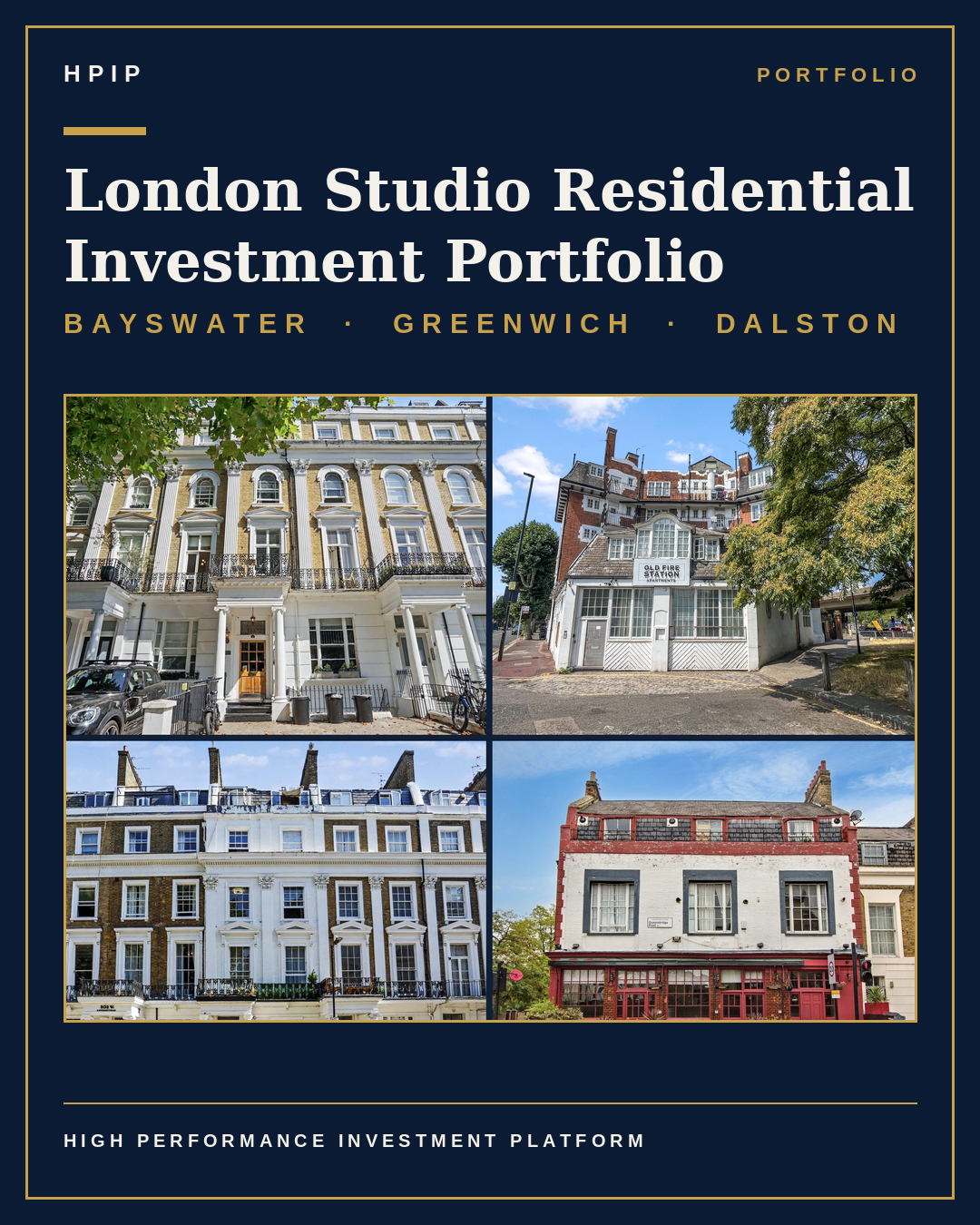
Frequently asked questions for Worldwide investors on the London studio portfolio and global markets
1. How are the four London studio blocks offered to investors from Worldwide?
The four blocks—two in Bayswater (W2), one in Greenwich (SE10), and one in Dalston (E8)—are offered individually by order of the fixed charge receivers ahead of auction, with bids due by 12 noon on Monday 11 January 2027.
2. How does HPC support buyers from Worldwide looking at this London portfolio?
HPC introduces qualified buyers from Worldwide, coordinates initial enquiries, and helps align buyer credentials and confidentiality arrangements prior to formal bid submission.
3. What is the occupancy and lease profile of the two Bayswater (W2) blocks?
Both Bayswater (W2) blocks are Grade II listed freeholds with zero reported unit vacancies, each let on an occupational tenancy or lease to PLGA running to 2028.
4. Why does the Greenwich (SE10) block currently show a lower gross yield than Dalston (E8)?
The Greenwich (SE10) freehold block has 15 vacant units (and two units marked n/a on the schedule) alongside assured periodic tenancies, creating leasing and refurbishment upside compared with Dalston (E8) where ten leasehold studios generate 9.82% gross.
5. What terms apply upon bid acceptance for any lot in the portfolio?
Upon bid acceptance, the buyer must sign the auction contract immediately, pay a 10% deposit, and pay an additional 1% fee to the receivers, subject to the legal pack and completion timescales.
6. What items must accompany a bid from an investor in Worldwide?
Bidders must provide the purchasing entity, solicitor details, certified ID and proof of address for each purchaser, proof of funds for at least 10% of the offer, confirmation of legal pack review, and confirmation of ability to sign the auction contract and pay the deposit immediately.
7. How do unsolicited UK public M&A approaches and activist shareholder M&A demands influence corporate buyers?
Unsolicited UK public M&A approaches and activist shareholder M&A demands highlight how boards and buyers move quickly on undervalued assets when market pricing diverges from underlying asset value.
8. How do UK and European investment banking leadership reshuffles and talent moves affect deal execution?
UK and European investment banking leadership reshuffles and talent moves can shift advisory teams mid-transaction, making experienced intermediaries and clear legal timelines essential.
9. How do mid-sized active asset manager mandate retention and institutional roster consolidation affect real estate capital?
Mid-sized active asset manager mandate retention and institutional roster consolidation concentrate capital among managers with disciplined underwriting and repeatable asset management capabilities.
10. How do bespoke retirement decumulation mandate design and pension risk transfer solutions affect UK income assets?
Bespoke retirement decumulation mandate design and pension risk transfer (PRT) solutions reinforce institutional interest in predictable UK rental cash flows alongside value-add residential opportunities.
11. How do UK National Wealth Fund co-investment mandates in defence technology and industrial manufacturing affect regional London demand?
UK National Wealth Fund co-investment mandates in defence technology and industrial manufacturing support broader UK industrial and technical employment, underpinning long-term housing demand.
12. What do FTSE 250 public-to-private buyouts and undervalued investment trust share buybacks signal for UK property buyers?
FTSE 250 public-to-private buyouts and undervalued investment trust share buybacks show investors capturing discounts to net asset value across UK public and private markets.
13. How do grid-connected battery storage, offshore wind, and data centre power interconnection assets relate to building upgrades?
Grid-connected battery storage, offshore wind, and data centre power interconnection assets reflect wider UK infrastructure investment and growing focus on energy efficiency and grid resilience.
14. How do UK private credit direct lending facilities and distressed corporate debt restructuring affect receiver-led sales?
UK private credit direct lending facilities and distressed corporate debt restructuring shape liquidity for borrowers and lenders, contributing to receiver-led real estate disposals and specialist debt funding.
15. How do cross-border transatlantic M&A advisory, technology transactions, and corporate carve-outs inform cross-border property buyers?
Cross-border transatlantic M&A advisory, technology transactions, and corporate carve-outs demonstrate the importance of strict legal diligence and clear separation of assets before closing.
16. How do FCA operational resilience, cyber risk supervision, and ESG reporting compliance impact institutional real estate?
FCA operational resilience, cyber risk supervision, and ESG reporting compliance raise governance and sustainability standards for regulated investors and lenders financing UK property.
17. How do European asset management operating models, AI infrastructure shifts, and fee pressure affect European allocators?
European asset management operating models, AI infrastructure shifts, and fee pressure highlighted at Future of Asset Management Europe in London push managers to control costs while targeting differentiated real asset returns.
18. How do cross-border European travel-tech M&A and strategic platform acquisitions relate to London short-stay and studio demand?
Cross-border European travel-tech M&A and strategic platform acquisitions following Kiwi.com's pending sale to Expedia Group underline continued travel and mobility demand in major European hubs like London.
19. How do European diesel demand forecasts, energy supply risks, and inflation pass-through from refinery attacks affect property operating costs?
European diesel demand forecasts, energy supply risks, and inflation pass-through from refinery attacks can influence utility, transport, and refurbishment costs, requiring conservative operating buffers.
20. How do European Innovation Council STEP Scale Up equity co-investment selections and European Investment Bank late-stage innovation fund-of-funds commitments affect European capital?
European Innovation Council (EIC) STEP Scale Up equity co-investment selections for deep-tech scale-ups and European Investment Bank (EIB) late-stage innovation fund-of-funds commitments support European innovation ecosystems alongside tangible real estate diversification.
21. How do European collateralised loan obligation tranche ratings, corporate treasury liquidity management, Schuldschein debt, insurance broker consolidation, and EU Foreign Subsidies Regulation filings shape cross-border deals?
European collateralised loan obligation (CLO) tranche ratings and structured finance debt issuances, corporate treasury liquidity management, Schuldschein debt, and working capital facilities, insurance broker consolidation and capital-light managing general agent (MGA) platforms, and cross-border M&A merger control and EU Foreign Subsidies Regulation filings govern European credit markets, risk transfer, and regulatory approvals.
22. How do semiconductor materials buyouts and corporate divestitures affect Asian technology capital?
Semiconductor materials buyouts and corporate divestitures led by Mitsui Chemicals' $11.5 billion acquisition of JSR Corporation show major Asian industrial groups reshaping portfolios and deploying substantial capital.
23. How do Asian fund distributor shifts toward equities and multi-asset funds as bond and ESG demand eases affect global portfolios?
Asian fund distributor shifts toward equities and multi-asset funds as bond and ESG demand eases reflect changing investor preferences across Asian wealth channels.
24. How do Brent crude oil price spikes, maritime supply chain risk from refinery attack claims, and US Treasury yield movements ahead of Thanksgiving affect global markets?
Brent crude oil price spikes and maritime supply chain risk following refinery attack claims alongside US Treasury yield movements and currency market positioning ahead of Thanksgiving influence energy prices, global freight, and cross-border borrowing rates.
25. How do outbound Indian corporate M&A, cross-border IP protection, global capability centre structuring, Hong Kong and Malaysian IPO bookbuilding, and Indonesian corporate credit ratings affect Asian investors?
Outbound Indian corporate M&A, cross-border IP protection, and global capability centre (GCC) structuring, Hong Kong and Malaysian IPO bookbuilding, REIT credit ratings, and spin-off introductions, and Indonesian corporate and banking credit ratings and domestic bond market issuances shape regional capital formation and outward diversification by buyers from Worldwide.
26. How do hyperscale AI data centre equity raises, US export control licensing compliance in Singapore and Malaysia, cross-border logistics in India and ASEAN, tokenised wholesale bank deposits, Japanese activist targets, and USD/JPY cross-currency basis swaps impact cross-border execution?
Hyperscale AI data centre equity raises and Southeast Asian power generation capacity, US export control licensing compliance for advanced AI chip procurement in Singapore and Malaysia, cross-border logistics, container shipping, and supply chain manufacturing acquisitions in India and ASEAN, tokenised wholesale bank deposits, digital securities exchanges, and 24/7 settlement rails, Japanese corporate governance activist targets and conglomerate asset divestitures, and foreign currency intervention thresholds and USD/JPY cross-currency basis swaps affect technology supply chains, settlement speed, and currency hedging into sterling.
27. How do African critical mineral investment platforms and graphite project financing shape emerging-market resource capital?
African critical mineral investment platforms and graphite project financing following Lionhead launching African Critical Minerals with a proposed $70 million investment in Tanzania's Mahenge Graphite Project highlight growing institutional backing for critical supply chains.
28. How do African mining debt-to-equity conversions, lithium processing progress, and mining finance bank approvals affect resource sponsors?
African mining debt-to-equity conversions, lithium processing progress, and mining finance bank approvals reflect evolving capital structures and credit underwriting in African resource projects.
29. How do large-ticket African infrastructure M&A, Gulf-Africa bilateral infrastructure, and African private credit facilities connect with international investors?
Large-ticket African infrastructure, energy, and mining M&A transactions, Gulf-Africa bilateral infrastructure, port logistics, and downstream fuel distribution co-investments, and African private credit facilities and larger-ticket institutional debt syndications demonstrate active emerging-market deal flow alongside UK real estate diversification.
30. How do Tier-1 copper and cobalt concessions, pan-African fintech, sovereign eurobond spreads, Mission 300 power finance, DFI blended-finance guarantees, telecoms towers, and commercial warehousing in Nairobi, Lagos, and Johannesburg compare with London residential studios?
Tier-1 copper, cobalt, and critical mineral mining concessions for energy transition supply chains, pan-African fintech, cross-border remittance infrastructure, and mobile money platforms, sovereign eurobond yield spreads and domestic local-currency treasury bill auctions, utility-scale renewable energy, green hydrogen, and Mission 300 power project finance, Development Finance Institution (DFI) blended-finance guarantees and political risk insurance, pan-African telecommunications towers and fibre-optic network acquisitions, and commercial real estate and industrial warehousing in Nairobi, Lagos, and Johannesburg serve different risk-return roles from London residential studios.
31. How does GCC debt advisory expansion amid a slower regional IPO pipeline affect Gulf capital markets?
GCC debt advisory expansion and non-dilutive financing amid a slower regional IPO pipeline led by EFG Hermes launching its GCC debt advisory business shows regional advisors expanding debt and structured financing solutions for sponsors.
32. How does Gulf banking consolidation and all-stock mergers shape regional financial institutions?
Gulf banking consolidation and all-stock mergers following Dubai Islamic Bank's agreement to acquire Emirates Islamic create larger regional balance sheets capable of supporting cross-border transactions.
33. How do sovereign wealth fund capital deployment, Strait of Hormuz energy transit risks, outbound Gulf acquisitions in Europe, and UK/European data centre joint ventures affect Gulf investors?
Sovereign wealth fund capital deployment, cross-border co-investments, and Strait of Hormuz energy transit risks, outbound Gulf sovereign wealth acquisitions in European industrial, defence, and AI infrastructure, and Gulf sovereign wealth principal investing in gigawatt-scale UK and European data centre joint ventures underscore how Gulf capital balances regional logistics risk with global real asset exposure.
34. How do GCC domestic M&A, global sukuk liquidity, GCC IPO bookbuilding, LNG offtake agreements, intra-GCC co-investment vehicles, and master-planned urban land parcels influence Gulf buyers?
GCC domestic M&A, downstream petrochemicals, and mid-market corporate consolidation, global sukuk secondary-market liquidity and sovereign Islamic bond spreads, GCC regional initial public offering (IPO) bookbuilding and foreign institutional allocations, liquefied natural gas (LNG) long-term offtake agreements and petrochemical downstream assets, intra-GCC sovereign wealth co-investment vehicles and cross-border industrial alliances, and master-planned urban development land parcels and hospitality brand management contracts shape Gulf liquidity and international real estate allocations.
35. How do bank lending caution on AI and data-centre loans tied to Chinese technology and private credit software exposure to AI disruption affect credit markets?
Bank lending caution on AI and data-centre loans tied to Chinese technology and private credit software exposure to AI disruption, valuation discipline, and high-yield market competition highlight tighter credit scrutiny across technology and leveraged lending.
36. How do PIPE transactions, municipal bond financing for domestic defence and drone facilities, North American institutional AuM expansion, US midstream energy credit upgrades, US enterprise AI buyouts, Latin American sovereign utility upgrades, Australian superannuation allocations, and US Treasury long-dated yield hedging affect global portfolios?
Private investment in public equity (PIPE) transactions and institutional growth capital allocations, municipal bond financing for domestic defence and drone manufacturing facilities, North American institutional AuM expansion, ETF inflows, and private-market allocation mandates, US midstream energy logistics credit upgrades and pipeline infrastructure consolidation, US enterprise AI and technology M&A buyouts and post-IPO institutional portfolio rotations, sovereign utility credit upgrades and Latin American infrastructure debt ratings, Australian superannuation fund direct infrastructure allocations and APRA regulatory compliance, and US Treasury long-dated yield hedging, Federal Reserve rate-path derivatives, and active fixed-income inflows shape how global allocators manage duration, sector exposure, and real assets.
37. Why are not all studio units internally inspected in the receiver brochure?
Some accommodation and tenancy information is unavailable or comes from a previous valuation, and not all flats have been internally inspected by the receivers' inspection agents, so buyers must rely on their own inspections and legal enquiries.
38. What tenure differences exist across the four lots in the London studio portfolio?
Three blocks—the two Bayswater (W2) properties and the Greenwich (SE10) property—are freehold and Grade II listed, whereas the Dalston (E8) property consists of ten studios held on 120-year leases from 25 March 2011.
39. What tenancy structure applies to the two Bayswater (W2) blocks?
Both Bayswater (W2) blocks are let to PLGA on occupational tenancies or leases running to 2028, with buyers advised to review the legal pack for full lease terms and any side letter provisions.
40. What tenancy structure applies to the Greenwich (SE10) and Dalston (E8) blocks?
Units in both the Greenwich (SE10) and Dalston (E8) blocks are let on assured periodic tenancies, with 15 vacant units (plus two units marked n/a) in Greenwich and two vacant units in Dalston.
41. Can an investor from Worldwide bid on just one lot rather than the full portfolio?
Yes, the four blocks are offered individually by informal tender to the set deadline, allowing buyers from Worldwide to bid on single lots or multiple lots separately.
42. What happens if a bid is submitted below the guide price for a lot?
Offers must be at or above the respective guide price, and the vendor retains rights to decline any offer, withdraw a property, change the method of sale, or call best and final offers.
43. How should buyers from Worldwide treat the gross yields and floor areas stated in the marketing material?
Gross yields and gross internal areas are approximate, calculated before costs, voids, management, and the 1% receivers' fee, and floorplans are illustrative and not to scale.
44. What heritage and regulatory checks are needed on the Grade II listed studio blocks?
Buyers must verify listed-building constraints, fire safety compliance, building regulations, and licensing or letting requirements with independent UK advisors and the legal pack.
45. Can a buyer from Worldwide purchase through a UK or overseas corporate entity?
Yes, buyers from Worldwide can bid through an eligible purchasing entity, provided full entity details, solicitor details, certified ID, proof of address, and proof of funds are supplied with the bid.
46. How does the 1% receivers' fee work in the transaction?
A fee of 1% of the purchase price is payable to the receivers in addition to the purchase price, subject to the special conditions in the legal pack.
47. What happens after exchange on the auction contract?
Once a bid is accepted and the auction contract is exchanged with the 10% deposit paid, completion must occur within the timescales set out in the special conditions of sale.
48. Does HPC act as agent for the vendor or the fixed charge receivers?
No, HPC acts as an introducer for buyers and is not retained by the vendor or the fixed charge receivers.
49. How does HPC coordinate introductions for international buyers?
HPC establishes clear confidentiality and introduction terms with prospective buyers from Worldwide before facilitating introductions and formal enquiries.
50. How can an investor from Worldwide get started on reviewing these London studio assets?
Buyers from Worldwide can contact HPC Consultancy Ltd directly to confirm their buyer credentials, align on confidentiality terms, and request further details ahead of the 11 January 2027 bid deadline.