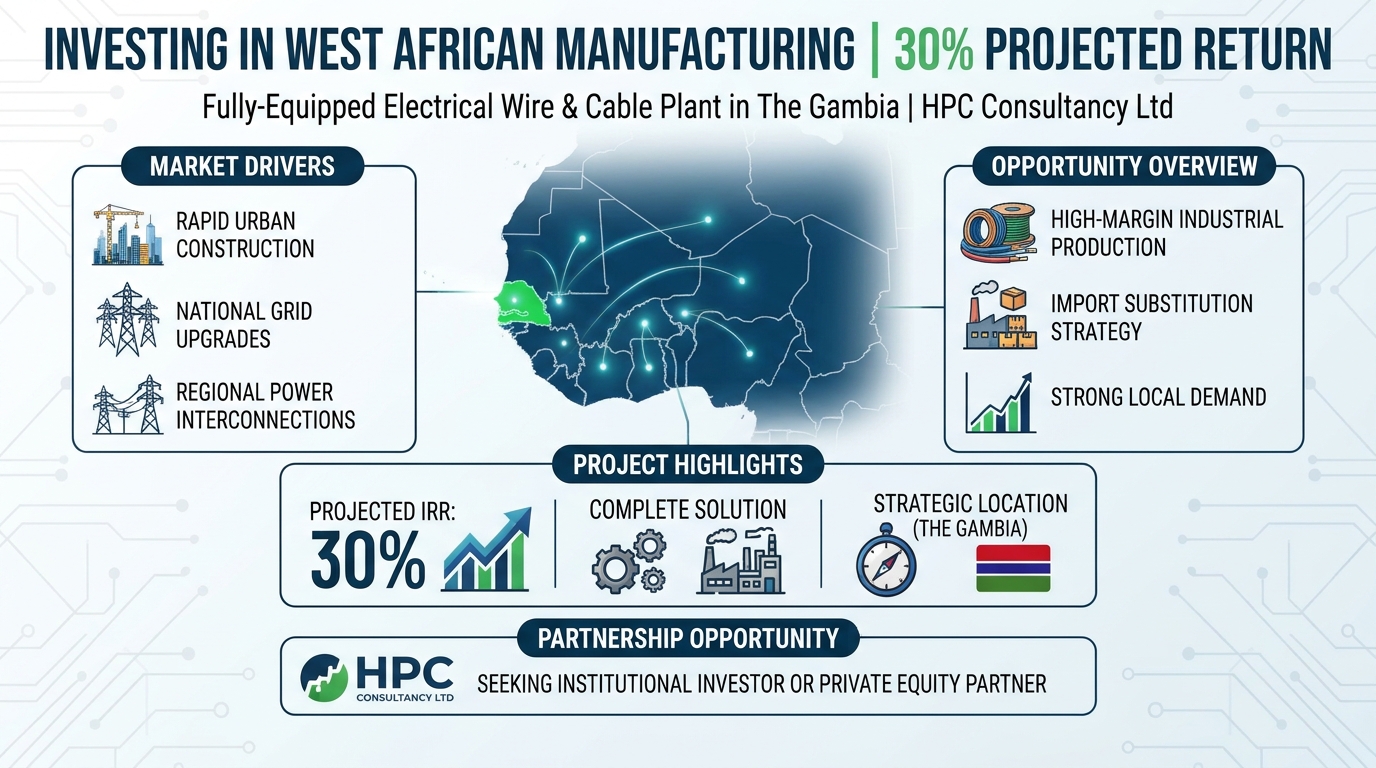
Global private capital is increasingly turning toward high-margin industrial production in emerging markets where local manufacturing replaces expensive imports. Across West Africa, rapid urban construction, national grid upgrades, and expanding regional power interconnections have created strong ongoing demand for electrical wires and cables. HPC Consultancy Ltd is currently seeking an institutional investor or private equity partner for a turnkey electrical wire and cable manufacturing plant in The Gambia, offering a projected 30 percent return on investment alongside a 50 percent equity stake.
Market opportunity in The Gambia and West Africa
The Gambia is undergoing sustained infrastructure expansion, including urban development, port activity, and ongoing power grid needs. Because local industrial capacity remains limited, domestic contractors and utility projects rely heavily on imported electrical cables, creating strong pricing power and immediate local demand for an in-country producer. Setting up a dedicated manufacturing facility in the Kanifing and Banjul area allows the business to serve local construction directly while accessing wider regional markets across West Africa.
Capital structure and 50 percent equity partnership
The project is structured as a transparent joint venture designed to protect incoming capital and align operational incentives from day one.
* Total investment requirement of US$378,000 secures a full 50 percent equity stake in the operating company, targeting a 30 percent annual return on investment.
* Capital allocation covers industrial cable-making machinery, factory rent and site setup, initial raw material stock such as copper rod and PVC compound, and advisory fees.
* Experienced operational leadership is led by a former international cricketer acting as working partner, who holds the remaining 50 percent equity and will relocate full-time to The Gambia to manage daily factory operations alongside skilled technical staff.
* Quarterly batch production cycles alternate one month of manufacturing with one month of sales and distribution, keeping working capital disciplined while building a 60 to 90 day raw material buffer.
Tax exemptions and institutional governance controls
Foreign direct investment into Gambian light manufacturing qualifies for substantial statutory incentives and strict financial oversight. Because the US$378,000 commitment exceeds the US$250,000 foreign investor threshold, the enterprise qualifies for a Gambia Investment and Export Promotion Agency Special Investment Certificate, granting exemption from import duties on capital goods and a five-year exemption from import VAT.
To safeguard investor capital, the company operates through a single dedicated Gambian bank account with dual-signature controls on major disbursements above an agreed threshold. The incoming investor receives board representation, weekly operational reports, monthly management accounts, quarterly batch profit-and-loss statements prior to any dividend distribution, and full inspection rights over factory inventory and financial records.
If your fund, family office, or private investment group is looking for a high-yield industrial manufacturing opportunity in West Africa, contact the HPC advisory team today to review the full due diligence dossier and financial projections.
Frequently asked questions for Worldwide investors on the Gambian electrical cable manufacturing investment
1. What is the core investment structure for the Gambian electrical wire and cable manufacturing plant?
An investor provides US$378,000 for a 50 percent equity stake in the operating company, targeting a 30 percent return on investment. A former international cricketer serves as the working partner holding the remaining 50 percent equity and leading full-time on-site operations.
2. How does HPC assist investors from Worldwide in evaluating this West African manufacturing mandate?
HPC provides independent commercial advisory, buyer credentialing, and structured deal coordination, connecting investors from Worldwide with verified project documentation and governance frameworks.
3. How does the production cycle operate across the year?
The plant runs a quarterly batch model consisting of one month of manufacturing followed by one month of sales and distribution, backed by a 60 to 90 day raw material buffer.
4. What tax exemptions apply to the project in The Gambia?
Because the US$378,000 investment exceeds the US$250,000 foreign investor threshold, the business qualifies for a Gambia Investment and Export Promotion Agency Special Investment Certificate offering import duty exemption on capital goods and a five-year import VAT exemption.
5. How are major disbursements and bank accounts controlled to protect investor capital?
The business operates through one dedicated Gambian bank account with dual-signature controls required for major non-routine disbursements above an agreed threshold, alongside weekly reports, monthly accounts, quarterly batch profit-and-loss statements, and annual audited accounts.
6. How do UK wealth management buyouts and cross-border private equity co-investments compare with direct emerging market joint ventures?
Major transactions such as UK wealth management buyouts and cross-border private equity co-investments following Mubadala and Centerbridge Partners' £1.17 billion joint buyout of Canaccord Genuity's UK wealth arm show strong institutional appetite for tangible cash flows, while direct industrial stakes offer hands-on operational equity.
7. How do UK bank capital ratios, net interest margins, and European financial sector M&A outlooks affect cross-border capital flows?
Insights on UK bank capital ratios, net interest margins, and European financial sector M&A outlooks highlighted at J.P. Morgan's Financials Conference in London remind global allocators to balance traditional banking exposures with high-growth real-economy investments.
8. How do distressed credit restructuring, creditor coordination, and private credit direct lending terms shape capital allocation?
Evolving practices in distressed credit restructuring, creditor coordination, and private credit direct lending terms lead many investors to prefer clean, unencumbered equity joint ventures over complex debt workouts.
9. How do UK gilt yield curve positioning and Bank of England rate-path hedging following fresh inflation data influence international investors?
Shifts in UK gilt yield curve positioning and Bank of England rate-path hedging following fresh inflation data prompt investors from Worldwide to diversify into real assets with local demand drivers.
10. How do UK North Sea upstream oil and gas asset disposals and decommissioning liabilities compare with light industrial manufacturing?
Unlike UK North Sea upstream oil and gas asset disposals and decommissioning liabilities that carry heavy end-of-life cleanup obligations, light cable manufacturing avoids complex offshore decommissioning exposure.
11. How do pre-permitted grid-connected battery storage and offshore wind energy assets complement electrical cable demand?
Expanding renewable grids and pre-permitted grid-connected battery storage and offshore wind energy assets increase long-term demand for power distribution cables and electrical infrastructure.
12. How do bulk annuity pension risk transfer mandates and longevity reinsurance deals interact with private capital?
Bulk annuity pension risk transfer (PRT) mandates and longevity reinsurance deals channel long-dated institutional capital into steady yield assets, while family offices and private investors often seek higher-growth industrial equity.
13. How do undervalued FTSE 250 public equities for sponsor-led take-private buyouts compare with private emerging market deals?
While sponsors pursue undervalued FTSE 250 public equities for sponsor-led take-private buyouts in public markets, private joint ventures allow direct partnership with active operators from day one.
14. How do AI-native biotech and life sciences spinouts for institutional venture allocation differ from manufacturing projects?
AI-native biotech and life sciences spinouts for institutional venture allocation carry long clinical timelines and binary regulatory risk, whereas cable manufacturing targets immediate physical demand for wiring and conductors.
15. How do secondary private equity LP stakes and GP-led continuation vehicles support portfolio liquidity?
Secondary private equity LP stakes and GP-led continuation vehicles help funds manage legacy positions, while direct operating ventures distribute profits after covering batch operating costs and raw material replenishment.
16. How do European data centre infrastructure buyouts and consortium bidding reflect global power demand?
European data centre infrastructure buyouts and consortium bidding as Apollo, Ardian, Macquarie, and Rai line up to acquire Retelit's data centres highlight rising power and connectivity needs across modern economies.
17. How do voluntary public tender offers in European aerospace and satellite technology signal strategic M&A trends?
Moves such as voluntary public tender offers in European aerospace and satellite technology following ICEYE's premium tender offer for Italian launch provider Avio show buyers paying for specialized technical capabilities.
18. How do European private equity advisory talent and Paris buyout deal pipelines support cross-border deal execution?
Growth in European private equity advisory talent and Paris buyout deal pipelines following Milbank launching in Paris by hiring Weil, Gotshal & Manges' French team underscores the value of experienced legal and commercial advisors on cross-border deals.
19. What do strategic corporate stake divestitures in European telecoms infrastructure tell investors about capital discipline?
Strategic corporate stake divestitures in European telecoms infrastructure highlighted by Nvidia trimming its stake in Nokia reflect active portfolio rebalancing across global technology and infrastructure holdings.
20. How do EU AI Act regulatory compliance obligations for private credit managers and institutional lenders affect financial institutions?
New rules around EU AI Act regulatory compliance obligations for private credit managers and institutional lenders increase compliance overhead for automated lending platforms.
21. How do European industrial and infrastructure initial public offering bookbuilding and defence equity financing shape risk appetite?
Active European industrial and infrastructure initial public offering (IPO) bookbuilding alongside European defence, dual-use aerospace, and autonomous systems equity financing demonstrates continued institutional backing for physical and industrial assets.
22. How do corporate bond tender offers and liability management exercises influence corporate balance sheets?
Corporate bond tender offers and liability management exercises help established borrowers manage refinancing costs and debt maturities in changing rate environments.
23. How do insurance broker consolidation and capital-light managing general agent platforms operate across Europe?
Insurance broker consolidation and capital-light managing general agent (MGA) platforms focus on fee-based distribution rather than heavy physical plant ownership.
24. How does Solvency II capital treatment for collateralised loan obligation debt tranches affect European insurers?
Solvency II capital treatment for collateralised loan obligation (CLO) debt tranches guides how insurers weigh structured credit risk against capital charges.
25. What do oversubscribed Indian qualified institutional placements and Asian tech sell-offs indicate for global investors?
Strong demand in oversubscribed Indian qualified institutional placements (QIPs) and equity capital market bookbuilding led by Urban Company's ₹2,500 crore QIP drawing over six times institutional demand contrasts with semiconductor supply chain equity hedging and Asian tech sell-off contagion as South Korea's KOSPI and Japan's Nikkei 225 slid over 5% alongside SoftBank's drop, encouraging balanced geographic exposure.
26. How do European private equity GP fundraising roadshows targeting Singapore, Hong Kong, and Tokyo institutional LPs affect cross-border capital?
European private equity GP fundraising roadshows targeting Singapore, Hong Kong, and Tokyo institutional LPs connect Asian institutional pools with international deal flow.
27. How do Japanese government bond issuance strategy and Bank of Japan rate expectations influence global markets?
Shifts in Japanese government bond (JGB) issuance strategy and Bank of Japan rate expectations affect global funding costs and currency flows.
28. Why are hyperscale AI data centre land parcels and Southeast Asian power capacity attracting infrastructure capital?
Hyperscale AI data centre land parcels and Southeast Asian power capacity draw capital due to long-term electricity and compute requirements.
29. How do pre-IPO late-stage secondary blocks and Japanese corporate governance activist targets create entry opportunities?
Pre-IPO late-stage secondary blocks in Asian tech and consumer conglomerates alongside Japanese corporate governance activist targets and conglomerate asset sales unlock corporate restructuring value.
30. How do cross-border supply chain manufacturing facilities in Vietnam, India, and Malaysia compare with West African industrial sites?
Cross-border supply chain manufacturing facilities in Vietnam, India, and Malaysia benefit from regional export networks, while local Gambian production serves domestic and regional West African demand directly.
31. How do tokenised wholesale bank deposits, foreign currency intervention thresholds, and USD/JPY cross-currency basis swaps affect cross-border finance?
Tokenised wholesale bank deposits and distributed ledger capital market settlement rails aim to speed up settlements, while foreign currency intervention thresholds and USD/JPY cross-currency basis swaps help manage currency swings.
32. How do critical mineral and uranium exploration exclusivity deals across Southern Africa and East African mining project financing shape African investment?
Critical mineral and uranium exploration exclusivity deals across Southern Africa and East African mining project financing and sovereign exploration licensing highlight growing resource activity across the continent.
33. What do oversubscribed East African industrial rights issues and exchange equity listings signal for African industrials?
Oversubscribed East African industrial rights issues and exchange equity listings show local and regional investor appetite for industrial growth.
34. How do mid-market M&A earn-out structures, succession buyouts, and carve-outs work amid elevated sovereign bond yields?
Mid-market M&A earn-out structures, succession buyouts, and carve-outs amid elevated sovereign bond yields help align buyer and seller expectations when financing costs are higher.
35. How do sovereign eurobond yield spreads, local-currency treasury bill auctions, and utility-scale renewable energy financing affect African projects?
Tracking sovereign eurobond yield spreads and local-currency treasury bill auctions alongside utility-scale renewable energy and carbon credit registration financing helps investors price country and currency risk.
36. How do pan-African telecommunications towers, fibre networks, DFI blended-finance guarantees, and commercial warehousing support regional growth?
Pan-African telecommunications towers, fibre networks, and mobile money platforms, Development Finance Institution (DFI) blended-finance guarantees and agricultural risk insurance, and commercial real estate and industrial warehousing in Nairobi, Lagos, and Johannesburg strengthen regional infrastructure and trade.
37. How do cross-border stock exchange settlement and Global Depositary Receipt integration benefit emerging market investors?
Cross-border stock exchange settlement and Global Depositary Receipt (GDR) integration improve international investor access to listed regional securities.
38. How do outbound sovereign wealth acquisitions in UK and European wealth management connect with global capital markets?
Outbound sovereign wealth acquisitions in UK and European wealth management led by Mubadala's $1.55 billion joint buyout of Canaccord's UK business underscore active Gulf capital deployment across global financial services.
39. What themes emerge from regional treasury liquidity management and the 6th GCC Financial Markets and Treasury Conference in Dubai?
Regional treasury liquidity management, FX risk hedging, and fixed-income market infrastructure highlighted at the 6th GCC Financial Markets and Treasury Conference in Dubai emphasize disciplined cash and currency management across cross-border operations.
40. How do GCC sovereign wealth outbound allocations into global AI compute, pre-IPO buyouts, and GCC IPO bookbuilding shape Gulf deal flow?
GCC sovereign wealth outbound allocations into global AI compute and digital infrastructure, regional private equity pre-IPO growth buyouts and mid-market consolidation, and GCC regional initial public offering (IPO) bookbuilding and foreign institutional allocations drive strong regional liquidity.
41. How do LNG offtake agreements, war-risk marine hull insurance rates, and sovereign sukuk issuances affect Gulf and maritime trade?
Liquefied natural gas (LNG) long-term offtake agreements and East-West pipeline export capacity, war-risk marine hull insurance rates and Strait of Hormuz transit rerouting logistics, and sovereign and quasi-sovereign sukuk issuances and syndicated project finance facilities shape regional energy and shipping risk.
42. How do localised defence manufacturing in Saudi Arabia and master-planned urban land parcels reflect Gulf diversification?
Localised defence manufacturing and renewable energy joint ventures in Saudi Arabia alongside master-planned urban development land parcels and hospitality brand management contracts support long-term economic diversification.
43. What do post-IPO institutional equity trading and AI valuation repricing after Anthropic ended its debut session at $97 show?
Post-IPO institutional equity trading and AI valuation repricing as Anthropic ended its debut session at $97 amid a broader Wall Street tech sell-off highlight valuation swings in high-multiple public tech listings.
44. How do US midstream energy private equity fundraises like EnCap Flatrock targeting $1.5 billion for its sixth midstream fund compare with physical assets?
US midstream energy private equity fundraises and pipeline infrastructure consolidation following EnCap Flatrock targeting $1.5 billion for its sixth midstream fund show ongoing demand for essential physical infrastructure.
45. How do Australian domestic corporate senior unsecured bond issuances and regulatory scrutiny of private credit valuations impact investors?
Australian domestic corporate senior unsecured bond issuances and bank note buybacks alongside Australian regulatory scrutiny of private credit fund valuations and conflicts of interest highlight the importance of transparent asset pricing.
46. How do sovereign wealth 13F equity portfolio rebalancing, music royalty catalogues, and US aviation and defence M&A debt financing affect portfolios?
Sovereign wealth and public pension fund 13F equity portfolio rebalancing and Q3 valuation shifts, music royalty catalogues and recurring intellectual property cash-flow buyouts, and US aviation and defence M&A acquisition debt financing and senior note offerings reflect varied return profiles across asset classes.
47. How do clinical-stage biotech M&A targets, wireless spectrum allocations, US regional bank consolidation, and US Treasury yield hedging shape institutional strategy?
Clinical-stage biotech M&A targets and follow-on equity offerings, public pension fund allocations into wireless spectrum and satellite infrastructure, US regional bank consolidation and merger arbitrage, and US Treasury long-dated yield hedging and Federal Reserve rate-path derivatives show how institutions balance growth, infrastructure, and rate protection.
48. What visas and permits are needed for working partners and technical staff in The Gambia?
Non-ECOWAS executives, managers, and skilled technicians require a Residence Permit B from the Gambia Immigration Department under an approved expatriate quota and labour-market test, while a non-resident shareholder not taking local employment uses a standard visitor visa for trips.
49. How are power supply and environmental approvals handled for the cable plant?
Because national grid power can be unreliable, the project budgets for a standby generator alongside a NAWEC industrial electricity application, plus registration with the Ministry of Justice, a Kanifing Municipal Council licence, and National Environment Agency environmental screening.
50. How can an investor from Worldwide request the full due diligence package from HPC?
Investors from Worldwide can contact the HPC advisory team directly to sign confidentiality terms, review the complete due diligence dossier, and confirm remaining operational details.