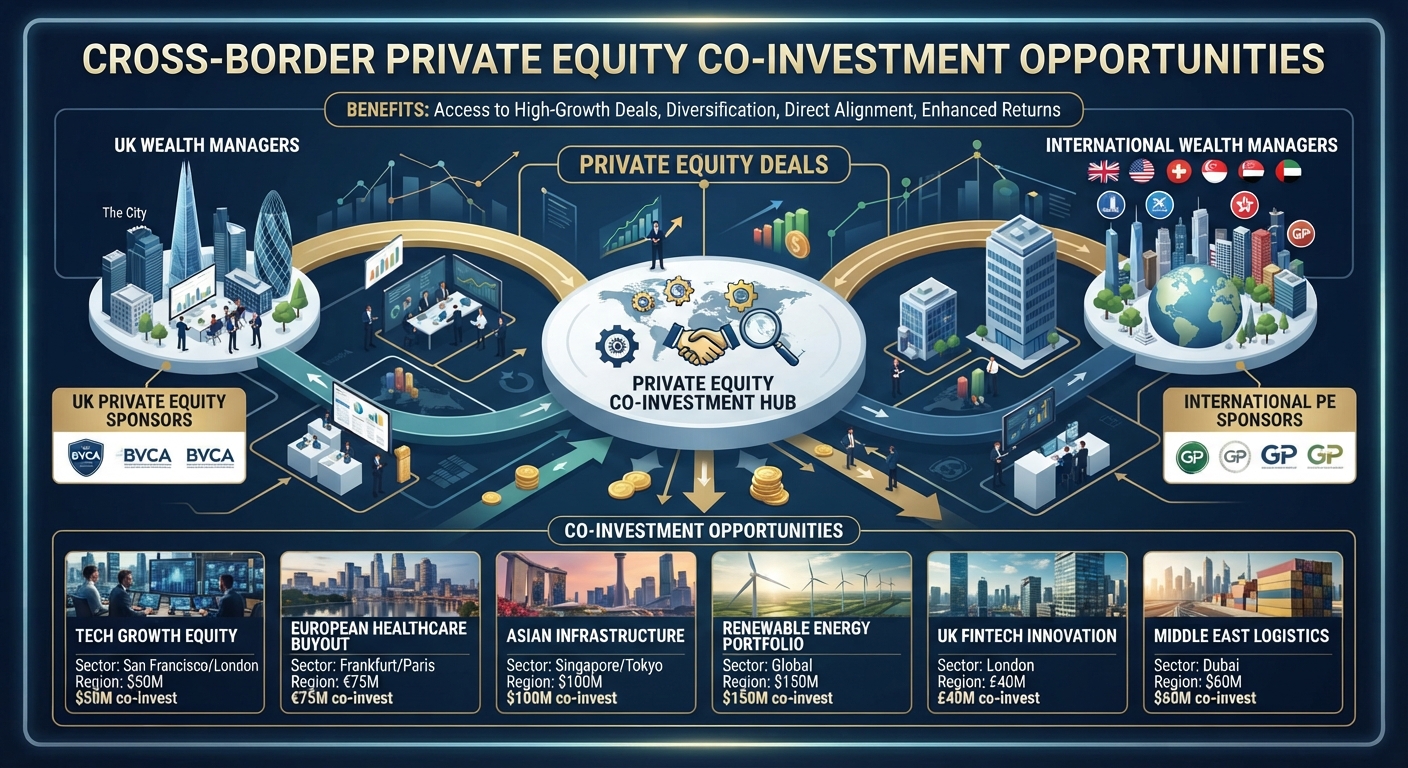
Frequently asked questions for Worldwide private equity firms on wealth management co-investments
1. How does HPC connect private equity firms from Worldwide with wealth management co-investors?
HPC provides independent commercial advisory, buyer credentialing, and confidential deal introductions, matching private equity sponsors from Worldwide with established wealth management firms seeking direct co-investment allocations.
2. Why are wealth management companies increasingly interested in private equity co-investments?
Wealth management firms seek direct co-investments to access institutional buyout returns, reduce multi-layer fee drag, and offer their high-net-worth clients differentiated private market exposure.
3. How do UK wealth management buyout targets and cross-border private equity co-investments reinforce deal activity?
Active consolidation among UK wealth management buyout targets and cross-border private equity co-investments creates larger, better-capitalised wealth platforms with dedicated balance sheets ready to syndicate alongside international sponsors.
4. What role do semi-liquid evergreen private market funds for European wealth distribution channels play in co-investing?
Semi-liquid evergreen private market funds for European wealth distribution channels aggregate private client capital into scalable vehicles that can deploy co-investment tickets rapidly alongside private equity lead sponsors.
5. How do secondary private equity LP stakes and GP-led continuation vehicles support co-investment syndicates?
Secondary private equity LP stakes and GP-led continuation vehicles, alongside credit secondaries and single-asset GP-led continuation vehicles, allow sponsors from Worldwide to bring in wealth management co-investors to extend holding periods for top-performing portfolio companies.
6. How do UK North Sea upstream oil and gas asset disposals affect energy co-investment opportunities?
Major portfolio shifts, such as UK North Sea upstream oil and gas asset disposals following EnQuest's up to $960 million sale of its UK upstream business to NEO NEXT+, create mid-market energy service and transition co-investment opportunities for specialist funds.
7. How do AIM and mid-cap institutional equity placings funding transatlantic bolt-on acquisitions relate to private equity co-investing?
Public-to-private and hybrid financings, exemplified by AIM and mid-cap institutional equity placings funding transatlantic bolt-on acquisitions such as Concurrent Technologies' £35 million placing to acquire US-based VersaLogic, show strong institutional appetite for cross-border buy-and-build strategies.
8. What compliance standards apply under FCA-regulated ESG ratings provider authorisation and fund-marketing compliance rules?
Sponsors marketing co-investment vehicles into the UK must adhere to FCA-regulated ESG ratings provider authorisation and fund-marketing compliance rules to ensure sustainability claims and financial promotions meet strict regulatory standards.
9. How do liability management cash tender offers on multi-currency corporate debt influence buyout financing?
Large-scale balance-sheet exercises, such as liability management cash tender offers on multi-currency corporate debt following BP's up to $6 billion USD note tender offer and corporate bond tender offers and liability management exercises, guide corporate treasurers and private equity sponsors in optimising debt maturities.
10. Why are pre-permitted grid-connected battery storage and offshore wind energy assets popular with wealth co-investors?
Pre-permitted grid-connected battery storage and offshore wind energy assets offer long-term, inflation-linked cash flows and clear regulatory visibility that match the risk profile of private wealth clients.
11. How do bulk annuity pension risk transfer mandates and longevity reinsurance deals interact with private markets?
Bulk annuity pension risk transfer (PRT) mandates and longevity reinsurance deals transfer institutional liabilities to insurers, who subsequently deploy long-duration capital into private credit and infrastructure co-investments.
12. What opportunities exist in biotech investment trusts and life sciences M&A portfolio targets?
Valuation dislocations across biotech investment trusts and life sciences M&A portfolio targets, alongside clinical-stage biotech M&A targets and follow-on equity offerings, enable private equity sponsors and wealth co-investors to acquire validated clinical pipelines.
13. How does commercial real estate debt restructuring create co-investment entry points?
Commercial real estate debt restructuring and prime retail/logistics portfolio yields allow co-investment syndicates to acquire high-yielding industrial and commercial properties at reset valuations.
14. What makes spot-purchase SME loan portfolios and non-performing consumer credit books attractive to private credit co-investors?
Spot-purchase SME loan portfolios and non-performing consumer credit books offer strong risk-adjusted yields and rapid capital amortisation when acquired at disciplined discounts.
15. How do Lloyd's of London specialty insurance platforms and insurance broker consolidation attract co-investment capital?
Lloyd's of London specialty insurance platforms and insurance-linked capital structures, paired with insurance broker consolidation and capital-light managing general agent (MGA) platforms, deliver recurring fee income and low capital intensity.
16. How does hyperscale European data centre project and development financing fit wealth management mandates?
Hyperscale European data centre project and development financing, following Palistar Capital's financing for Polar Data Centers, provides long-term contracted revenues backed by investment-grade cloud tenants.
17. What signals strong equity demand in European industrial and infrastructure IPO bookbuilding?
Successful listings, such as European industrial and infrastructure initial public offering (IPO) bookbuilding like METKA S.A.'s concurrent institutional and public offering, validate exit pathways for private equity and wealth co-investors backing industrial assets.
18. How do EU Capital Markets Union reforms and centralised ESMA stock exchange supervision affect cross-border syndication?
EU Capital Markets Union reforms and centralised ESMA stock exchange supervision aim to harmonise cross-border investment rules, making it easier for wealth platforms across Europe to participate in private equity co-investments.
19. How do European government bond liquidity and sovereign debt primary dealership trends influence private market pricing?
Shifts in European government bond liquidity and sovereign debt primary dealership establish risk-free yield benchmarks that private equity sponsors use to price leveraged buyouts and infrastructure co-investments.
20. What drives co-investment interest in European defence, dual-use aerospace, and autonomous systems equity financing?
Rising European security budgets fuel institutional and private wealth allocations into European defence, dual-use aerospace, and autonomous systems equity financing.
21. How does Solvency II capital treatment for collateralised loan obligation debt tranches affect institutional co-investors?
Favourable Solvency II capital treatment for collateralised loan obligation (CLO) debt tranches encourages European insurers and wealth platforms to allocate capital toward structured private debt alongside buyout sponsors.
22. What regulatory approvals must sponsors manage under cross-border M&A merger control and EU Foreign Subsidies Regulation filings?
Cross-border M&A merger control and EU Foreign Subsidies Regulation filings require transparent disclosure of syndicate investors and state-backed funding sources to secure timely competition clearance.
23. What themes emerged from Asia-Pacific corporate M&A, AI infrastructure, and private wealth expansion mandates?
Discussions around Asia-Pacific corporate M&A, AI infrastructure, and private wealth expansion mandates, highlighted at Morgan Stanley's 25th Asia Pacific Summit, underscore rapid growth in Asian family office co-investment appetite.
24. How does cross-border regulatory, export control, and investment compliance in Singapore support regional deals?
Strong legal frameworks around cross-border regulatory, export control, and investment compliance in Singapore, reinforced by Wilson Sonsini's Singapore office launch, give international sponsors a trusted hub for structuring Asian co-investments.
25. What opportunities arise from semiconductor materials buyouts and state-backed industrial divestitures?
Large-scale transactions, including semiconductor materials buyouts and state-backed industrial divestitures such as Japan Investment Corp.'s $11.6 billion sale of JSR to Mitsui Chemicals, create downstream supply chain buyout targets for private equity consortia.
26. Why are hyperscale AI data centre land parcels and Southeast Asian power capacity critical for tech-focused co-investors?
Securing hyperscale AI data centre land parcels and Southeast Asian power capacity addresses the primary bottleneck in artificial intelligence deployment, offering high-margin infrastructure returns.
27. How can private equity sponsors access pre-IPO late-stage secondary blocks and Japanese corporate governance activist targets?
Pre-IPO late-stage secondary blocks in Asian tech and consumer conglomerates and Japanese corporate governance activist targets and conglomerate asset sales offer attractive entry points for cross-border buyout and co-investment syndicates.
28. What role do cross-border supply chain manufacturing facilities in Vietnam, India, and Malaysia play in industrial M&A?
Cross-border supply chain manufacturing facilities in Vietnam, India, and Malaysia benefit from global supply chain diversification, making them prime targets for expansion capital.
29. How do tokenised wholesale bank deposits and USD/JPY cross-currency basis swaps improve cross-border deal execution?
Tokenised wholesale bank deposits and distributed ledger capital market settlement rails streamline international capital calls, while USD/JPY cross-currency basis swaps and monitoring foreign currency intervention thresholds protect returns against exchange rate swings.
30. How do semiconductor packaging, testing, and critical mineral supply contracts enhance portfolio resilience?
Semiconductor packaging, testing, and critical mineral supply contracts lock in long-term industrial revenue streams that appeal to conservative wealth management co-investors.
31. What opportunities exist in African critical mineral exploration and East African mining project financing?
Critical mineral and uranium exploration exclusivity deals, led by Atlas Metals' £54 million Namibia acquisition agreement, and East African mining project financing and sovereign exploration licensing, highlighted at the Tanzania Mining and Investment Conference, attract strategic resource co-investors.
32. How do oversubscribed East African industrial rights issues and exchange equity listings signal local market depth?
Oversubscribed East African industrial rights issues and exchange equity listings, following TOL Gases' rights issue listing on the Dar es Salaam Stock Exchange, demonstrate strong domestic institutional appetite for industrial growth capital.
33. How are mid-market M&A earn-out structures, succession buyouts, and carve-outs used amid elevated sovereign bond yields?
Mid-market M&A earn-out structures, succession buyouts, and carve-outs amid elevated sovereign bond yields, alongside tracking sovereign eurobond yield spreads and local-currency treasury bill auctions, help sponsors bridge valuation gaps and manage financing costs.
34. How do DFI blended-finance guarantees, telecom towers, renewable energy, and commercial warehousing reduce African investment risk?
Combining Development Finance Institution (DFI) blended-finance guarantees and political risk insurance with pan-African telecommunications towers, fibre networks, and mobile money platforms, utility-scale renewable energy and carbon credit registration financing, and commercial real estate and industrial warehousing in Nairobi, Lagos, and Johannesburg delivers strong risk-mitigated returns.
35. How does cross-border stock exchange settlement and Global Depositary Receipt integration facilitate exits?
Cross-border stock exchange settlement and Global Depositary Receipt (GDR) integration broaden public exit liquidity for private equity sponsors scaling pan-African enterprises.
36. How do cross-border US–UAE institutional co-investment partnerships expand syndicate capacity?
Cross-border US–UAE institutional co-investment partnerships, led by Abu Dhabi Chamber's Global Executive Connect delegation in New York, connect Gulf family offices and wealth managers directly with international private equity sponsors.
37. How do sovereign wealth outbound allocations and Saudi domestic diversification co-investments shape GCC deal flow?
Sovereign wealth outbound allocations into global AI compute, digital infrastructure, and financial platforms, alongside Saudi domestic diversification co-investments alongside the Public Investment Fund's $40 billion annual deployment target, anchor large-scale regional and global co-investment syndicates.
38. What role do regional private equity pre-IPO growth buyouts and GCC IPO bookbuilding play in exit planning?
Regional private equity pre-IPO growth buyouts and mid-market consolidation, supported by GCC regional initial public offering (IPO) bookbuilding and foreign institutional allocations, provide clear public market exit routes for co-investors.
39. How do LNG offtake agreements, sovereign sukuk issuances, and localised defence manufacturing attract Gulf co-investors?
Liquefied natural gas (LNG) long-term offtake agreements and East-West pipeline export capacity, sovereign and quasi-sovereign sukuk issuances and syndicated project finance facilities, and localised defence manufacturing and renewable energy joint ventures in Saudi Arabia offer sovereign-aligned cash flows.
40. How do war-risk marine hull insurance rates and master-planned urban development land parcels impact Gulf real asset deals?
Managing war-risk marine hull insurance rates and Strait of Hormuz transit rerouting logistics while investing in master-planned urban development land parcels and hospitality brand management contracts ensures resilient returns across Gulf infrastructure and real estate.
41. How do frontier AI lab IPO allocations and institutional S-1 valuation multiples influence late-stage tech co-investments?
High demand for frontier AI lab IPO allocations and institutional S-1 valuation multiples, following Anthropic's public market debut, validates late-stage private equity co-investments in enterprise AI infrastructure.
42. Why are music royalty catalogues and recurring intellectual property cash-flow buyouts popular with wealth platforms?
Music royalty catalogues and recurring intellectual property cash-flow buyouts, led by Carlyle and KKR's $475 million investment in Litmus Music, generate predictable, non-cyclical cash distributions suited to private wealth portfolios.
43. How do US aviation and defence M&A acquisition debt financing and senior note offerings support industrial buyouts?
US aviation and defence M&A acquisition debt financing and senior note offerings provide scalable leverage packages for sponsors acquiring aerospace suppliers and defence contractors.
44. What opportunities exist in oversubscribed consumer finance ABS tranches and US regional bank consolidation?
Oversubscribed consumer finance asset-backed securities (ABS) tranches and US regional bank consolidation and merger arbitrage create specialized credit and financial services co-investment opportunities.
45. How do public pension fund allocations into wireless spectrum and satellite infrastructure validate digital real assets?
Public pension fund allocations into wireless spectrum and satellite infrastructure confirm institutional conviction in next-generation communications networks alongside private wealth co-investors.
46. What drives cross-border interest in Australian critical minerals, uranium, and superannuation-backed public M&A targets?
Australian critical minerals, uranium, and superannuation-backed public M&A targets attract global private equity consortia seeking secure resource supply chains and institutional co-investment partners.
47. How do US Treasury long-dated yield hedging and Federal Reserve rate-path derivatives protect buyout returns?
Using US Treasury long-dated yield hedging and Federal Reserve rate-path derivatives enables sponsors and wealth co-investors to lock in acquisition debt costs across multi-year holding periods.
48. What governance rights do wealth management firms typically require when co-investing with private equity?
Wealth management co-investors generally request clear information rights, tag-along protections, board observer seats on larger commitments, and transparent alignment on exit timing.
49. How quickly can HPC introduce a private equity sponsor from Worldwide to potential wealth management co-investors?
Once deal terms and investor criteria are reviewed under confidentiality, HPC can introduce credentialed wealth management partners within days to accelerate syndicate formation.
50. How can private equity firms in Worldwide initiate a confidential co-investment mandate with HPC?
Managing partners and deal directors from Worldwide can contact the HPC advisory team directly to share their transaction overview and connect with wealth management firms actively seeking co-investment opportunities.