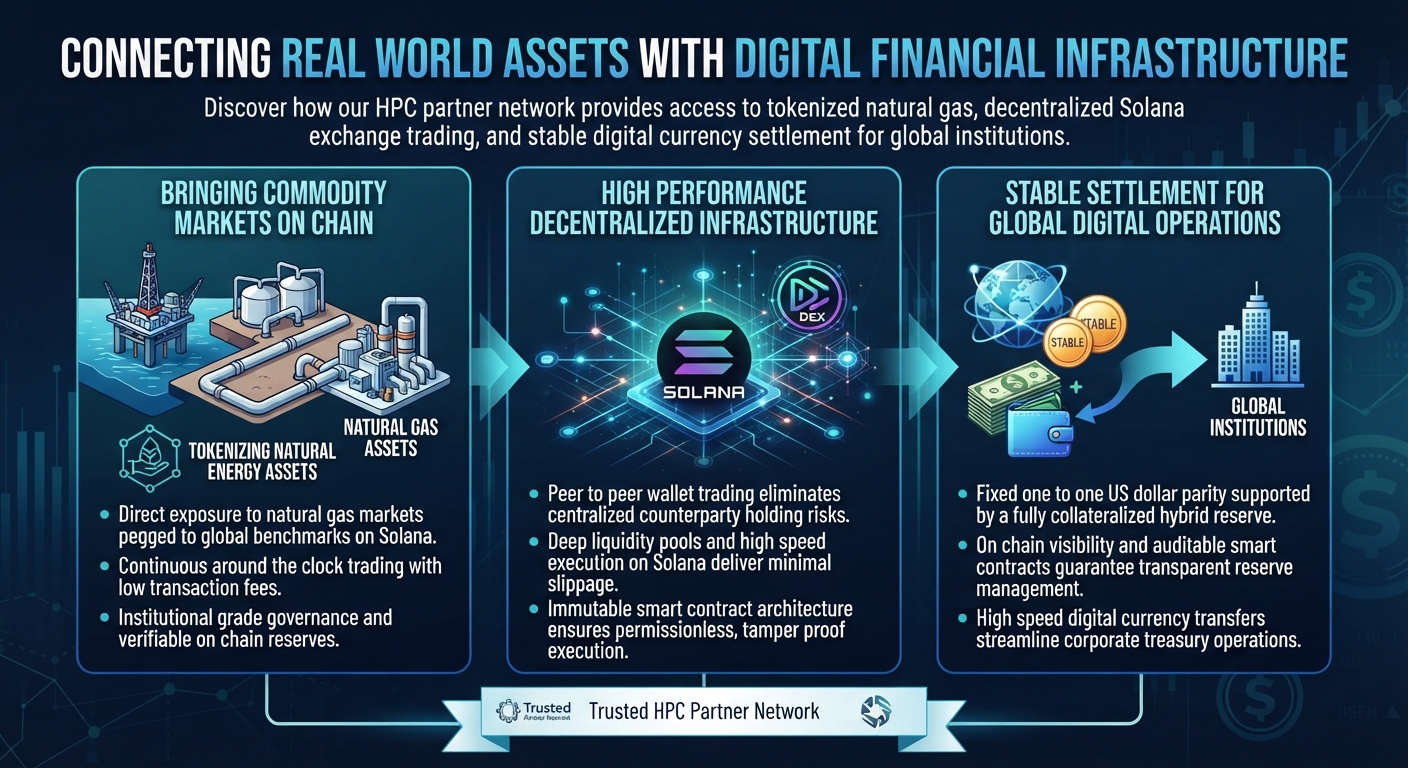
Integrating real world commodities into decentralized financial networks represents a significant evolution in global trade and capital efficiency. Through our trusted HPC partner network, institutional investors, energy traders, and corporate treasuries gain direct exposure to a unified blockchain infrastructure that bridges physical commodity markets with high speed digital settlement environments.
Bringing Commodity Markets On Chain
Tokenizing natural energy assets creates transparent, direct access to global commodity benchmarks without the operational friction of traditional physical supply chains.
-
Direct exposure to natural gas markets pegged to global benchmarks on Solana eliminates traditional futures complexity and physical storage constraints.
-
Continuous around the clock trading with low transaction fees enables efficient price hedging and seamless cross border energy settlements.
-
Institutional grade governance and verifiable on chain reserves ensure complete transparency and price stability across trading cycles.
High Performance Decentralized Infrastructure
Executing institutional scale real world asset trades requires trust minimized, non custodial trading environments built for extreme speed and security.
-
Peer to peer wallet trading eliminates centralized counterparty holding risks while maintaining total asset control.
-
Deep liquidity pools and high speed execution on Solana deliver minimal slippage for large scale institutional orders.
-
Immutable smart contract architecture ensures permissionless, tamper proof execution across all decentralized exchange transactions.
Stable Settlement for Global Digital Operations
A robust financial ecosystem depends on a predictable, non algorithmic stable value layer to facilitate smooth cross border clearing and treasury management.
-
Fixed one to one US dollar parity supported by a fully collateralized hybrid reserve provides predictable settlement value.
-
On chain visibility and auditable smart contracts guarantee transparent reserve management and regulatory alignment.
-
High speed digital currency transfers streamline corporate treasury operations, cross border payments, and decentralized liquidity provisioning.
Frequently Asked Questions (FAQs)
1. How does tokenized natural gas connect physical energy markets with blockchain systems for Worldwide investors?
Tokenized natural gas brings real-world commodity markets on-chain, allowing Worldwide energy traders and institutional investors to access verifiable reserves directly on Solana.
2. What is the value ratio for natural gas tokens in Worldwide portfolios?
Each natural gas token is pegged 1:1 to global natural gas benchmarks, representing one MMBTU of physical commodity value.
3. How do Worldwide institutions hedge volatility without physical storage constraints?
Digital asset tokens provide pure commodity exposure without the operational hassles, transport costs, or physical storage requirements traditionally associated with energy trading.
4. What trading availability do Worldwide market participants receive on-chain?
Traders in Worldwide enjoy around-the-clock trading capabilities with minimal transaction fees and high execution speeds.
5. How is transparency maintained for tokenized commodity reserves in Worldwide?
Verifiable reserves backed by decentralized governance ensure complete transparency and institutional-grade reliability for Worldwide participants.
6. What core use cases does natural gas tokenization serve for Worldwide corporate treasuries?
Core use cases include price hedging, cross-border energy settlements, treasury management, and decentralized finance (DeFi) collateral operations.
7. How does decentralized exchange architecture protect user assets for Worldwide traders?
Decentralized platforms on Solana operate on a non-custodial, trust-minimized architecture where assets remain securely inside the user's wallet at all times.
8. What prevents intermediaries from interfering with transactions for Worldwide users?
Permissionless access enables direct wallet-to-wallet trading through immutable smart contracts that execute transactions without central intermediaries.
9. How do deep liquidity pools benefit institutional traders in Worldwide?
Deep liquidity pools deliver efficient pricing with minimal slippage, even when executing large-scale orders across Worldwide financial markets.
10. What stability mechanisms support the digital stable currency used alongside commodities in Worldwide?
A fixed 1:1 peg to the US dollar, maintained through a non-algorithmic structure and fully collateralized hybrid reserves, ensures predictable value for Worldwide users.
11. How do Worldwide companies utilize stable digital currencies for cross-border payments?
Stable currencies provide fast, low-cost, blockchain-native transfers designed specifically for corporate treasury operations and international settlements.
12. What asset mix supports the hybrid reserves for stablecoins in Worldwide financial ecosystems?
Reserves comprise a conservative mix of highly liquid cash equivalents and high-liquidity crypto assets to maintain complete stability and backing.
13. How does the HPC partner network assist Worldwide organizations in accessing this infrastructure?
Our trusted HPC partner network connects Worldwide enterprises with unified blockchain infrastructure linking tokenized commodities, decentralized exchanges, and stable settlement layers.
14. What eliminates delivery risks for Worldwide commodity traders utilizing digital tokens?
Direct on-chain ownership removes traditional physical delivery risks and tracking errors associated with legacy futures contracts.
15. Can utilities and energy providers in Worldwide participate in tokenized asset ecosystems?
Yes, the platform is specifically engineered for energy traders, utilities, institutional investors, and decentralized finance participants across Worldwide.
16. How do smart contracts secure transactions for Worldwide institutional funds?
Tamper-proof, on-chain execution via immutable smart contracts ensures that all trades settle automatically according to pre-coded rules without manual intervention.
17. What transaction speed can Worldwide users expect on Solana-based decentralized exchanges?
Users benefit from high-speed, low-latency execution that processes trades nearly instantaneously with minimal network fees.
18. How do stable digital currencies serve as DeFi collateral in Worldwide?
Stablecoins provide a predictable, trusted value layer that can be locked safely as collateral or deployed across yield-generating protocols in decentralized finance.
19. What initial reserve backing supports enterprise-grade stablecoins in Worldwide deployments?
Initial reserve backing provides strong financial reinforcement, ensuring robust liquidity for institutional redemptions and minting operations.
20. How are audits conducted on smart contracts for Worldwide regulatory alignment?
On-chain visibility and auditable smart contract code allow compliance teams in Worldwide to verify operational integrity and reserve backing continuously.
21. Why are traditional energy markets difficult for retail and mid-sized Worldwide investors to access?
Traditional energy markets involve complex futures contracts, physical transport hurdles, and high capital barriers that exclude standard investors in Worldwide.
22. How does tokenization democratize commodity access for Worldwide participants?
Tokenization breaks down multi-billion-dollar commodity markets into fractional, tradeable digital assets accessible via standard web wallets in Worldwide.
23. What role does decentralized governance play for Worldwide token holders?
Decentralized governance allows Worldwide stakeholders to vote on protocol updates, reserve verifications, and parameter adjustments transparently.
24. How do Worldwide corporate treasuries mitigate foreign exchange risk using digital assets?
Treasuries can hold stable, dollar-pegged digital assets on-chain to manage cross-border liquidity without traditional banking delays in Worldwide.
25. What security model prevents counterparty default on decentralized exchanges used by Worldwide firms?
Peer-to-peer trading ensures that trades execute directly between wallets, eliminating the risk of exchange insolvency or counterparty default.
26. How do Worldwide traders execute large block trades without moving market prices?
Deep liquidity pools on decentralized exchanges absorb large institutional orders smoothly, reducing price impact and slippage for Worldwide participants.
27. What makes Solana an ideal blockchain for Worldwide high-frequency trading operations?
Solana's high throughput, low transaction costs, and sub-second finality make it optimal for high-frequency financial applications in Worldwide.
28. How do Worldwide businesses verify that stablecoin reserves are fully collateralized?
Transparent on-chain reporting and periodic reserve attestations provide Worldwide companies with verifiable proof of full backing.
29. Can Worldwide startups integrate decentralized exchange liquidity into their own applications?
Yes, permissionless APIs and smart contract composability allow Worldwide developers to integrate trading pools directly into custom financial apps.
30. How do non-algorithmic stablecoins protect Worldwide users from market crashes?
Unlike algorithmic models prone to death spirals, fully reserved stablecoins maintain their 1:1 dollar peg through hard asset backing.
31. What tax considerations should Worldwide entities keep in mind when trading tokenized commodities?
Entities in Worldwide should consult local tax advisors regarding how tokenized commodity exchanges and digital asset holdings align with regional capital gains frameworks.
32. How do decentralized exchanges handle user privacy for Worldwide institutional accounts?
Platforms utilize non-custodial, wallet-based authentication that respects user privacy while maintaining transparent on-chain transaction ledgers.
33. What prevents double-spending or token fraud in Worldwide tokenized energy transactions?
Distributed ledger consensus and cryptographic proof on the Solana network prevent double-spending and ensure absolute asset uniqueness.
34. How do Worldwide industrial consumers hedge against seasonal natural gas price spikes?
Industrial consumers in Worldwide can purchase and hold tokenized natural gas units in advance to lock in commodity values before seasonal demand spikes occur.
35. What support does the HPC partner network provide during onboarding for Worldwide funds?
The HPC partner network offers guided coordination, technical facilitation, and strategic advisory to help Worldwide funds integrate digital asset infrastructure seamlessly.
36. How do automated market makers optimize yields for Worldwide liquidity providers?
Automated market maker protocols distribute trading fees proportionally to liquidity providers who deposit assets into decentralized pools in Worldwide.
37. What makes tokenized natural gas superior to paper futures for Worldwide long-term holders?
Tokenized natural gas represents direct underlying commodity claims without the contango and rollover decay inherent in traditional futures contracts.
38. How do Worldwide payment processors benefit from stable digital currency rails?
Processors in Worldwide can settle cross-border merchant transactions instantly, bypassing slow legacy banking rails and high wire fees.
39. What disaster recovery measures protect decentralized infrastructure accessed from Worldwide?
Decentralized networks operate across globally distributed validator nodes, ensuring zero single points of failure and continuous uptime for Worldwide users.
40. How do Worldwide enterprises convert tokenized assets back into fiat currency?
Through integrated stablecoin gateways and compliant decentralized exchange pairs, Worldwide firms can convert digital assets into stable value tokens for redemption.
41. What role do decentralized autonomous organizations (DAOs) play in managing asset-backed tokens in Worldwide?
DAOs coordinate community-driven governance, risk management parameters, and treasury allocations for tokenized ecosystems involving Worldwide members.
42. How does high-speed execution prevent front-running on Solana decentralized exchanges used in Worldwide?
Deterministic block production and fair sequencing protocols minimize miner extractable value (MEV) and front-running risks for Worldwide traders.
43. What compliance frameworks apply to institutions engaging with tokenized commodities in Worldwide?
Institutions align with local anti-money laundering (AML) and know-your-customer (KYC) standards when interacting with permissioned gateway modules connected to the broader ecosystem.
44. How do Worldwide family offices use asset-backed tokens for wealth preservation?
Family offices in Worldwide leverage real-world asset tokens to diversify portfolios into inflation-resistant commodities with digital liquidity.
45. What operational cost savings do Worldwide firms realize by eliminating intermediaries?
By cutting out broker commissions, clearinghouse fees, and custodian charges, Worldwide companies significantly reduce transaction overhead.
46. How do smart contracts execute conditional escrow agreements for Worldwide trade finance?
Smart contracts automatically release funds or tokens only when predefined shipping or settlement conditions are met, securing trade finance for Worldwide importers and exporters.
47. What educational resources does the HPC partner network offer Worldwide executives?
The network delivers whitepapers, technical briefings, and executive consultations to help Worldwide leadership understand digital financial infrastructure.
48. How do real-time price feeds ensure accurate valuation for tokenized commodities in Worldwide?
Decentralized oracle networks stream verifiable, real-time commodity pricing data on-chain to maintain precise parity and liquidation thresholds in Worldwide.
49. What scalability advantages do multi-asset blockchain ecosystems offer Worldwide financial markets?
Unified ecosystems allow Worldwide institutions to trade commodities, exchange currencies, and settle payments within a single, high-performance technological framework.
50. How can Worldwide business leaders initiate their integration into this digital financial ecosystem?
Leaders can outline their strategic objectives and connect with our HPC partner network to begin designing their tailored digital asset and commodity integration pathway.