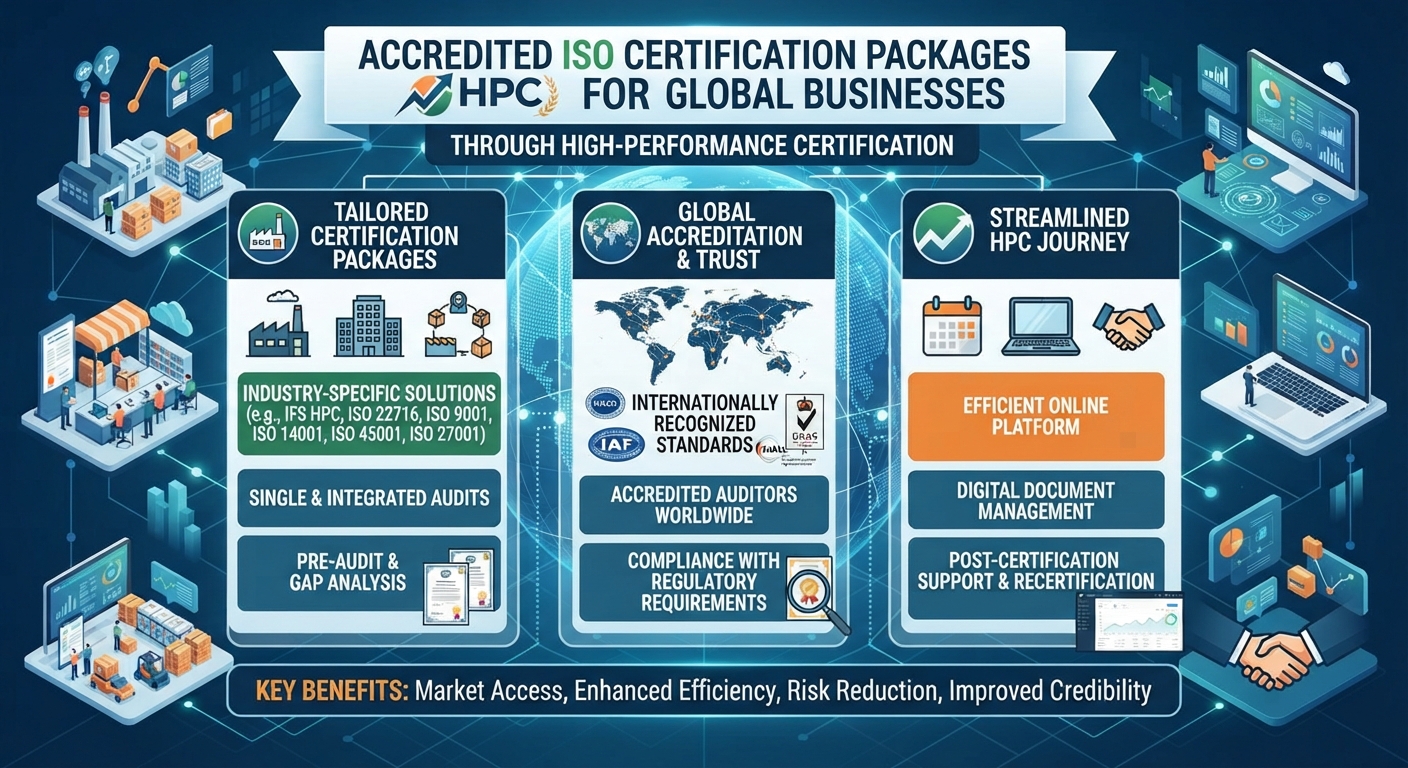
Frequently asked questions for Worldwide businesses on ISO certification and global markets
1. How does HPC help businesses in Worldwide obtain ISO certificates?
HPC coordinates the certification journey from initial scope review and documentation readiness to audit scheduling and certificate delivery across major international management standards.
2. How are HPC's ISO certification prices structured compared with the reference rate card?
HPC prices ISO certification packages at double the base reference schedule figures, covering full advisory coordination and commercial packaging across initial, surveillance, recertification, and three-year terms.
3. Which core ISO standards can Worldwide businesses pursue through HPC?
Businesses can pursue ISO 9001:2015 for quality, ISO 14001:2015 for environment, ISO 45001:2018 for health and safety, ISO 22000:2018 for food safety, ISO/IEC 27001:2022 for information security, ISO 13485:2016 for medical devices, ISO 50001:2018 for energy management, and ISO 37001:2016 for anti-bribery.
4. What does the certification process typically involve?
The process covers selecting the right standard, defining scope, reviewing existing management systems, addressing gaps or non-conformities, completing two-stage initial audits, and maintaining certification via annual surveillance audits over a three-year cycle.
5. How does UK National Wealth Fund co-investment mandates in domestic defence technology and industrial manufacturing affect industrial suppliers?
Growth in UK National Wealth Fund co-investment mandates in domestic defence technology and industrial manufacturing increases supply chain demand for certified quality, safety, and security management systems among industrial contractors.
6. Why do FCA final rules on reformed client categorisation, operational resilience, and cyber risk supervision for institutional asset managers matter to vendors?
Tighter expectations around FCA final rules on reformed client categorisation, operational resilience, and cyber risk supervision for institutional asset managers push financial and tech suppliers toward formal information security and operational controls.
7. How do UK travel and leisure M&A change-of-control approvals, ATOL bonding tests, and customer prepayment ring-fencing relate to operational standards?
Strict oversight in UK travel and leisure M&A change-of-control approvals, ATOL bonding tests, and customer prepayment ring-fencing highlights why regulated operators rely on documented processes and financial controls during transactions.
8. What does asset manager roster consolidation and bespoke retirement decumulation mandate design mean for service providers?
Trends in asset manager roster consolidation and bespoke retirement decumulation mandate design following PwC research showing 53% of global distributors expect to cut manager rosters mean only well-governed, audit-ready firms win institutional mandates.
9. How does UK gilt yield curve positioning and Bank of England rate-path hedging ahead of year-end portfolio rebalancing affect corporate budgets?
Shifts in UK gilt yield curve positioning and Bank of England rate-path hedging ahead of year-end portfolio rebalancing encourage companies to control costs and improve operational efficiency through standardised processes.
10. How do UK wealth management buyout targets and sovereign-backed private equity co-investments shape governance expectations?
Activity in UK wealth management buyout targets and sovereign-backed private equity co-investments raises institutional expectations for risk management, compliance documentation, and board reporting.
11. Why are pre-permitted grid-connected battery storage and offshore wind energy assets linked to energy management standards?
Expanding pre-permitted grid-connected battery storage and offshore wind energy assets aligns with energy efficiency goals where ISO 50001 helps organisations track and cut energy use.
12. How do bulk annuity pension risk transfer mandates and longevity reinsurance deals influence corporate risk standards?
Large bulk annuity pension risk transfer (PRT) mandates and longevity reinsurance deals reflect institutional focus on long-term liability and risk management across financial markets.
13. How does commercial real estate debt restructuring and prime industrial/data centre supply chain facilities affect infrastructure operators?
Activity in commercial real estate debt restructuring and prime industrial/data centre supply chain facilities makes documented safety, uptime, and facility standards valuable for operators and lenders.
14. How do secondary private equity LP stakes and GP-led continuation vehicles support longer-term operational upgrades?
Secondary private equity LP stakes and GP-led continuation vehicles give portfolio companies extended timelines to implement operational improvements and compliance certifications before exit.
15. What do European travel and hospitality private equity buyouts and cross-border licensing clearances signal for service firms?
Momentum in European travel and hospitality private equity buyouts and cross-border licensing clearances as disclosed European leisure M&A reaches $9.8 billion year-to-date shows strong interest in compliant, scalable service operators.
16. How do delisting and scheme-of-arrangement settlements on Euronext Dublin and the London Stock Exchange affect cross-border companies?
Transactions such as delisting and scheme-of-arrangement settlements on Euronext Dublin and the London Stock Exchange following Bluefin's completed cash acquisition of Irish Continental Group show how cross-border buyouts consolidate transport and logistics operators.
17. What does European Parliament rejection of Retail Investment Strategy reforms and implications for fund distribution channels mean for compliance?
Debates around European Parliament rejection of Retail Investment Strategy reforms and implications for fund distribution channels remind firms to keep client disclosures and governance practices clear across jurisdictions.
18. How do European defence, industrial capacity, and nuclear power generation M&A mandates impact suppliers?
Growing European defence, industrial capacity, and nuclear power generation M&A mandates increase requirements for strict safety, quality, and anti-bribery controls across industrial supply chains.
19. How do European Union primary dealer sovereign bond auctions and euro-area yield curve positioning affect corporate financing?
Movements in European Union primary dealer sovereign bond auctions and euro-area yield curve positioning shape borrowing costs for European and international businesses funding expansion.
20. Why are pre-built data centre capacity and high-voltage power interconnection assets tied to information security and energy standards?
Operators of pre-built data centre capacity and high-voltage power interconnection assets rely on strong information security and energy management frameworks to protect uptime and data integrity.
21. How do insurance broker consolidation and capital-light managing general agent platforms affect risk standards?
Insurance broker consolidation and capital-light managing general agent (MGA) platforms favour partners with repeatable workflows, clear risk controls, and documented compliance.
22. How does Solvency II capital treatment for collateralised loan obligation debt tranches shape institutional credit?
Rules governing Solvency II capital treatment for collateralised loan obligation (CLO) debt tranches influence how insurers price structured credit and assess counterparty risk.
23. What must businesses watch with cross-border M&A merger control and EU Foreign Subsidies Regulation filings?
Navigating cross-border M&A merger control and EU Foreign Subsidies Regulation filings requires transparent corporate records and compliance discipline across borders.
24. How do semi-liquid evergreen private market funds for European wealth distribution channels affect portfolio companies?
Semi-liquid evergreen private market funds for European wealth distribution channels bring private wealth capital into long-term assets that benefit from strong governance and reporting.
25. What do Asia-Pacific corporate M&A, take-private control buyouts, and activist shareholder targets indicate for corporate boards?
Activity in Asia-Pacific corporate M&A, take-private control buyouts, and activist shareholder targets pushes boards to strengthen operational efficiency and governance transparency.
26. How do hyperscale AI data centre land parcels and Southeast Asian power generation constraints affect operators?
Managing hyperscale AI data centre land parcels and Southeast Asian power generation constraints makes energy efficiency and reliable infrastructure management critical for operators.
27. How do DRAM and semiconductor supply chain equities alongside thematic hardware ETF flows impact hardware suppliers?
Volatility in DRAM and semiconductor supply chain equities alongside thematic hardware ETF flows encourages hardware makers to maintain consistent quality and supply chain controls.
28. How do Asian sovereign wealth fund and APAC family office direct co-investment mandates shape cross-border deals?
Asian sovereign wealth fund and APAC family office direct co-investment mandates across AI, private credit, and core-plus infrastructure look for scalable, well-governed businesses with clear operational metrics.
29. Why are cross-border supply chain manufacturing facilities in Vietnam, India, and Malaysia focused on international standards?
Cross-border supply chain manufacturing facilities in Vietnam, India, and Malaysia use recognised management standards to satisfy global buyers and export requirements.
30. How do pre-IPO late-stage secondary blocks in Asian tech and consumer conglomerates affect company readiness?
Pre-IPO late-stage secondary blocks in Asian tech and consumer conglomerates often precede stricter institutional audits, data security reviews, and governance upgrades.
31. How do tokenised wholesale bank deposits and distributed ledger capital market settlement rails relate to security standards?
Advances in tokenised wholesale bank deposits and distributed ledger capital market settlement rails heighten the need for robust information security controls such as ISO/IEC 27001.
32. How do Asian crude oil term supply agreements and maritime freight hedging affect logistics companies?
Asian crude oil term supply agreements and maritime freight hedging help energy and shipping firms manage fuel and freight cost swings across trade routes.
33. What do Japanese corporate governance activist targets and conglomerate asset divestitures show about corporate value?
Japanese corporate governance activist targets and conglomerate asset divestitures highlight how divesting non-core units and tightening operations can unlock business value.
34. How do foreign currency intervention thresholds and USD/JPY cross-currency basis swaps affect cross-border businesses?
Tracking foreign currency intervention thresholds and USD/JPY cross-currency basis swaps helps international firms manage currency swings on cross-border contracts and payments.
35. What do African mining and aluminum value-chain divestitures and critical mineral M&A mean for industrial suppliers?
Activity in African mining and aluminum value-chain divestitures and critical mineral M&A accounting for roughly three-quarters of inbound African deal value increases demand for health, safety, and environmental compliance in resource operations.
36. How do downstream fuel retail and energy distribution acquisitions across Southern Africa shape operator standards?
Downstream fuel retail and energy distribution acquisitions across Southern Africa require consistent safety, environmental, and operational controls across retail and depot networks.
37. How do sovereign eurobond yield spreads and domestic local-currency treasury bill auctions affect African borrowers?
Sovereign eurobond yield spreads and domestic local-currency treasury bill auctions shape local funding costs and currency risk for companies operating across Africa.
38. Why are Tier-1 copper, cobalt, and critical mineral mining concessions focused on environmental and safety compliance?
Operators of Tier-1 copper, cobalt, and critical mineral mining concessions for strategic acquisition must meet strict environmental and workplace safety expectations to maintain social licence and lender support.
39. How do private rail corridor concessions and port logistics infrastructure privatisation affect supply chains?
Private rail corridor concessions and port logistics infrastructure privatisation create faster transport links while requiring standardised safety and quality management across logistics operators.
40. How do utility-scale renewable energy and carbon credit registration financing connect with environmental standards?
Utility-scale renewable energy and carbon credit registration financing aligns with environmental and energy management systems that track emissions and resource efficiency.
41. What role do pan-African telecommunications towers, fibre networks, and mobile money platforms play in digital growth?
Pan-African telecommunications towers, fibre networks, and mobile money platforms support digital commerce and rely on dependable service and security management.
42. How do DFI blended-finance guarantees, commercial real estate in Nairobi, Lagos, and Johannesburg, and GDR integration support growth?
Development Finance Institution (DFI) blended-finance guarantees and agricultural risk insurance, commercial real estate and industrial warehousing in Nairobi, Lagos, and Johannesburg, and cross-border stock exchange settlement and Global Depositary Receipt (GDR) integration help businesses scale and access international capital.
43. How does Abu Dhabi energy and infrastructure legal and advisory hub expansion affect regional projects?
Moves such as Abu Dhabi energy and infrastructure legal and advisory hub expansions following Mayer Brown opening its Abu Dhabi office to lead regional energy and infrastructure mandates reflect growing legal and transactional support in the Gulf.
44. What does GCC wealth management growth and family office private market allocations signal for private businesses?
Insights on GCC wealth management growth and family office private market allocations highlighted by the Middle East Investment Panorama Report point to rising Gulf capital looking for well-structured, compliant businesses.
45. How do outbound Gulf sovereign wealth acquisitions, AI compute allocations, and regional pre-IPO buyouts shape deal flow?
Outbound Gulf sovereign wealth acquisitions in global aviation leasing, logistics, gaming, and midstream energy infrastructure, GCC sovereign wealth outbound allocations into global AI compute and digital infrastructure, and regional private equity pre-IPO growth buyouts and mid-market family business succession deals drive active cross-border transactions.
46. How do GCC IPO bookbuilding, LNG offtake agreements, war-risk marine hull insurance, sovereign sukuk, and master-planned urban land parcels fit Gulf markets?
GCC regional initial public offering (IPO) bookbuilding and foreign institutional allocations, liquefied natural gas (LNG) long-term offtake agreements and petrochemical downstream assets, war-risk marine hull insurance rates and Strait of Hormuz transit rerouting logistics, sovereign and quasi-sovereign sukuk issuances and syndicated project finance facilities, and master-planned urban development land parcels and hospitality brand management contracts support long-term Gulf infrastructure and trade.
47. What do US enterprise fintech take-private buyouts and space and defence SPAC combinations show about M&A?
Deals such as US enterprise fintech and payments take-private buyouts led by TPG Capital and Corpay's $6 billion all-cash takeover of BILL at a 31% premium and US space and defence SPAC business combinations following Quantum Space completing its merger with Inflection Point VI and listing on the NYSE with $300 million raised show strong strategic appetite in fintech, space, and defence.
48. How do sponsor-backed middle-market debt facilities and US healthcare IT and nearshore staffing roll-ups affect growth companies?
Transactions like sponsor-backed middle-market debt financing and unitranche acquisition facilities such as Monroe Capital supporting Waveborn's acquisition of Jake Rosen Entertainment and US healthcare IT and nearshore staffing private equity roll-ups following CSI Companies acquiring HCTec and Diatonic Healthcare taking a majority stake in a nearshore platform highlight active debt and roll-up capital for mid-sized firms.
49. How do Australian superannuation and APRA scrutiny, data centre joint ventures, US Treasury hedging, pre-IPO blocks, Latin American private markets, and credit secondaries shape global capital?
Trends across Australian superannuation and institutional portfolio positioning alongside APRA scrutiny of offshore material service providers, Australian data centre and industrial real estate joint ventures, US Treasury 10-year yield hedging, Federal Reserve rate-hike probability derivatives, and short-duration treasury ETFs, pre-IPO secondary market blocks in frontier AI and aerospace companies, Latin American private markets LP-GP deal sourcing and direct lending allocations, and credit secondaries and single-asset GP-led continuation vehicles show how global investors manage risk, liquidity, and outsourcing oversight.
50. How can a business in Worldwide start an ISO certification enquiry with HPC?
Businesses in Worldwide can contact the HPC advisory team directly to share their industry scope, target ISO standards, and timeline in confidence.